

Executive Summary
Worldwide PC shipments fell 20.1 percent in the third quarter to 62.7 million units, the steepest third-quarter decline IDC has recorded. The cause is not weak demand on its own. The AI memory shortage pushed DRAM and NAND flash to nearly 40 percent of a PC component bill, up from about 15 percent a year earlier, because AI data centers bought the wafers first.
The squeeze is arriving inside the cloud as well. Microsoft is cutting included OneDrive storage for Microsoft 365 subscribers by as much as 4 TB, and TrendForce expects enterprise SSD contract prices to rise 23 to 28 percent this quarter. Samsung’s memory business earned roughly 109 trillion won in the quarter, more than the entire company’s operating profit.
Worldwide PC shipments fell 20.1 percent year on year in the third quarter to 62.7 million units. That is the largest third-quarter decline the IDC PC tracker has ever recorded, and it is far worse than the 3.8 percent drop in the second quarter. Shipments also slipped 9.1 percent from the second quarter to the third, which inverts the normal pattern where back-to-school makes the third quarter the bigger one.
Demand did not disappear. Vendors and channel partners pulled orders forward into the first half of the year to get ahead of memory price increases, so the second half opened with full warehouses and buyers unwilling to pay more. Omdia counts 58.1 million units, down 21.2 percent, and says upstream component cost increases have now fully worked through to end market pricing.
The bill moved off the processor and onto the memory
The reason the quarter was so ugly is cost rather than desire. DRAM and solid state storage now make up nearly 40 percent of a PC component bill, up from around 15 percent previously, after more than fourfold price increases. A year ago the processor was the expensive part. Now the memory is.
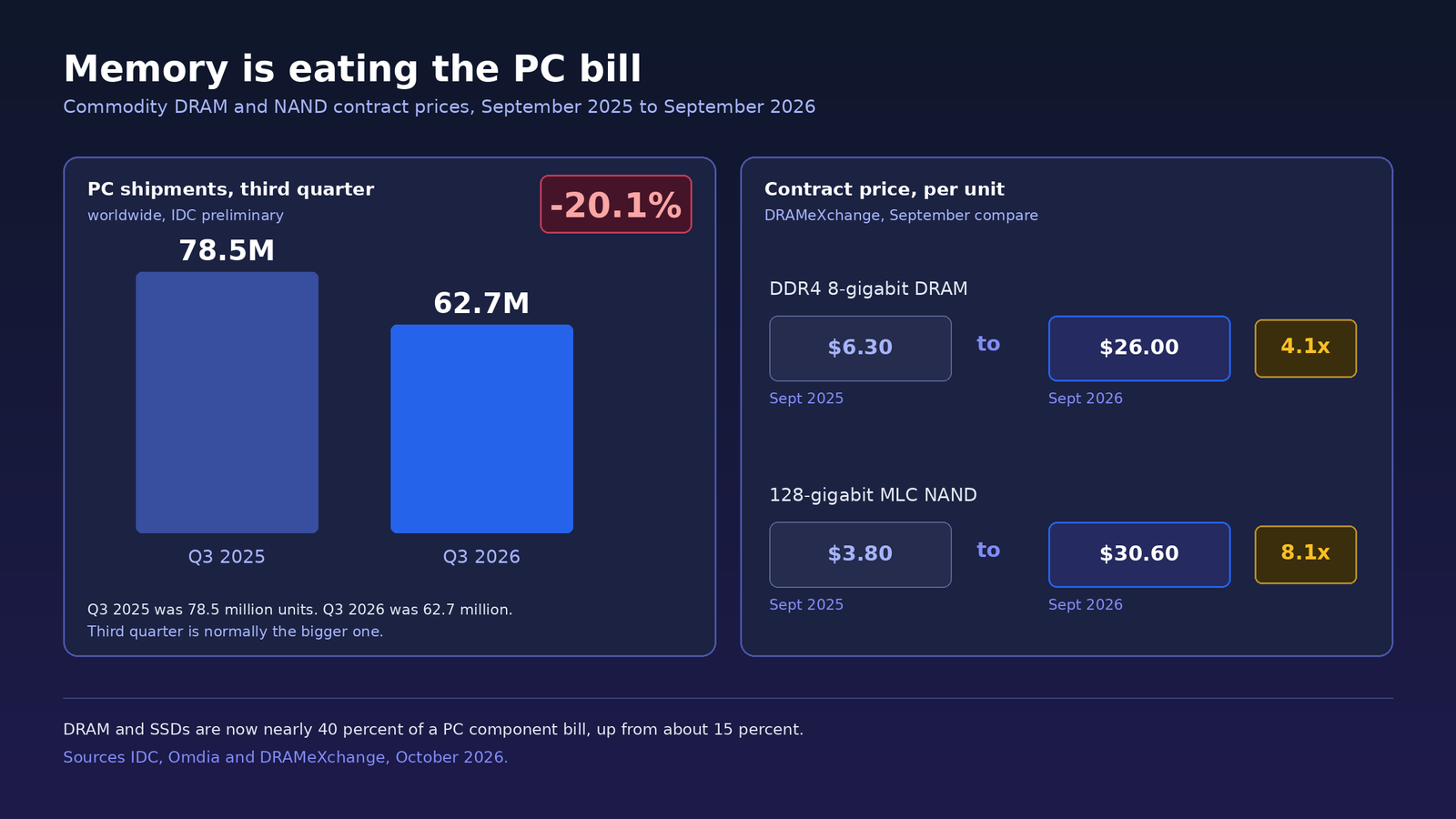
The commodity contract numbers show how far the move went. Korean market pricing puts DDR4 8-gigabit DRAM at $26.00 a unit in September 2026, up from $6.30 a year earlier, and 128-gigabit MLC NAND at $30.60, up from $3.80. Those are the cheap cylinders, not the high bandwidth kind, and both went up inside twelve months.
Why the low end first, when neither part touches an accelerator? TrendForce expects conventional DRAM contract prices to rise another 10 to 15 percent this quarter and NAND another 15 to 20 percent, with enterprise SSDs the single category where the increase accelerates, at 23 to 28 percent. Suppliers keep steering advanced wafers toward server products. Every wafer that goes into high bandwidth memory or a server RDIMM is one fewer for the commodity parts that fill a notebook.
Cloud buyers reached the front of the queue first
Micron closed its fiscal year on September 30 and told investors that more than 75 percent of its 2027 output is already committed, across contracted customers and ordinary purchase orders alike. The company has signed 26 strategic customer agreements carrying $32 billion of customer commitments, mostly cash deposits, and says customers are asking for supply assurances past 2030.
That is the part operators should sit with. This is not a spot market event a buyer can wait out. It is a queue, and the front of it was sold on multi-year terms with price floors and ceilings before most PC vendors finished their 2026 forecast.
Samsung shows who is winning. Its memory business is estimated to have produced about 109 trillion won of operating profit on a margin near 76 percent, enough to cover losses elsewhere in the company. Memory margins are now running roughly ten points above Nvidia’s. Nobody in that supply chain is in a hurry to change it.
What an operator should do this week
The practical consequence is that a refresh plan built on last year’s unit prices is wrong by a wide margin. Notebook configurations are already being cut back to protect bills of material, so the sensible reactions are to extend the life of machines that still work, to price memory and storage as separate line items instead of bundled with endpoints, and to check whether the cloud services you resell carry a storage allowance that is quietly shrinking.
Microsoft already demonstrated the third one. The company is reducing included OneDrive capacity for shared Microsoft 365 accounts by as much as 4 TB, citing industrywide shortages, which is what a vendor does when an input it resells becomes scarce and expensive.
Three questions worth applying to your own environment. If your endpoint refresh is priced off memory spot prices, when does the next cycle get re-approved? Which vendor contracts pass component cost through automatically, and which ones hold a price? And if the memory queue runs into 2028, what fails first in your capacity plan, the compute or the storage that feeds it?
Related reading. GlobalFoundries just took the AI chip bottleneck to New York, and the cheapest new AI capacity is the hardware already paid for.
Get the next one before it is old news
Independent analysis of cloud-native infrastructure, Kubernetes and data center economics. No vendor spin.
[…] Read the full analysis […]