


Executive Summary
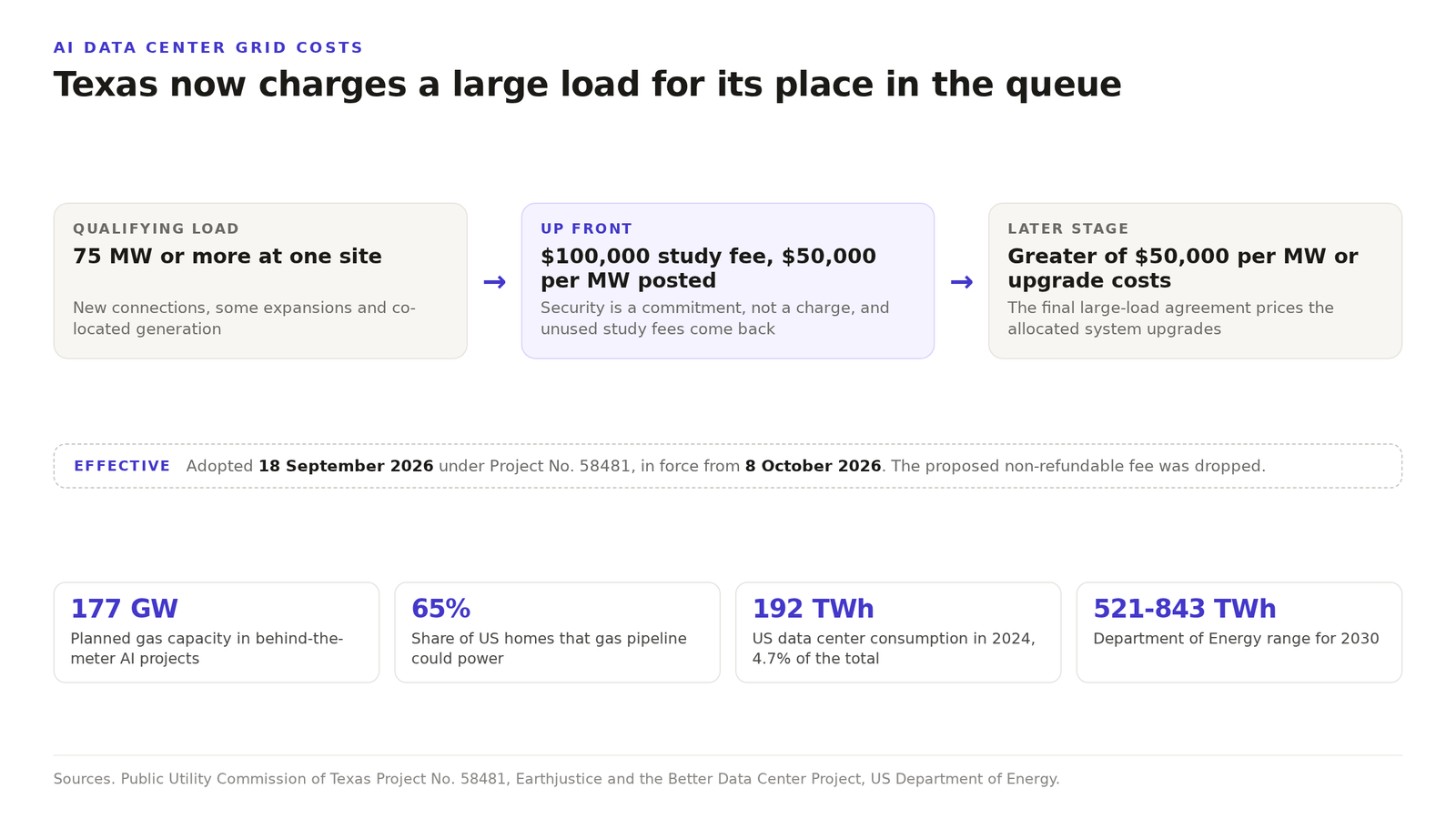
Texas started charging large electricity users for their place in the interconnection queue on 8 October. The Public Utility Commission of Texas adopted new large-load standards on 18 September under Project No. 58481. A load of 75 megawatts or more at a single site now owes a $100,000 study fee and must post financial security of $50,000 per megawatt of requested peak demand before the ERCOT study begins. At the later agreement stage, that security becomes the greater of $50,000 per megawatt or the allocated cost of the system upgrades the load requires.
The finding is that the cost of serving AI load is being moved from the ratepayer to the developer, and the behind-the-meter alternative is being challenged at the same time. Earthjustice and the Better Data Center Project counted 177 gigawatts of planned gas capacity in bring-your-own-power projects, enough to power 65 percent of US homes, with over half using less efficient generators. Cheap capacity is over. Priced capacity is the new normal.
The queue stopped being free in Texas this week.
A load of 75 megawatts or more at one site now enters the ERCOT interconnection process with money attached. The customer signs an intermediate agreement, discloses the site and its power supply, pays a $100,000 study fee to the interconnecting utility and posts security of $50,000 for every megawatt of requested peak demand. A one gigawatt campus posts $50 million before a single study is complete.
Security is a commitment, not a charge
The distinction matters for anyone modelling this, and the commission drew it carefully. It is also the clearest signal yet that AI data center grid costs are moving to the developer. Unused study fees are returned. Financial security is a commitment against obligations, generally the greater of $50,000 per megawatt of contracted peak demand or the allocated system upgrade costs at the final agreement stage, with earlier cash collateral credited. The commission also dropped a proposed non-refundable interconnection fee from the final rule, which tells you how the trade-off was weighed.
What changed is not the arithmetic alone. It is who carries the study cost when a project does not proceed. Under the old treatment, a speculative load could occupy study capacity and leave the upgrade bill to everyone else. Now the developer funds the analysis and posts collateral against the outcome. Expect that to sort serious projects from press releases quickly, because $50 million of collateral is a decision a board makes, not a website makes.
Washington wants the same thing, with a lower threshold
Washington is moving the same way. The bipartisan Senate permitting deal unveiled on 30 September would require data centers to pay for all associated transmission costs so the bill does not land on families and businesses, and it would ease siting of interstate transmission lines while strengthening the Federal Energy Regulatory Commission’s authority to review major projects alongside the states. Axios reported on 8 October that the data center requirement starts at 20 megawatts and covers the generation, storage, transmission and distribution costs a load adds, with regulators able to charge above cost and use the surplus to lower other customers’ bills. A 20 megawatt threshold is a third of the Texas one and the scope is national, so the pricing question is no longer a Texas question.
The counterweight is behind-the-meter generation, and it is being counted now. A report published on 8 October by Earthjustice and the Better Data Center Project, titled The AI Gas Rush, tallies 177 gigawatts of planned gas capacity in bring-your-own-power projects. The authors say that is enough to power 65 percent of US homes, that more than half of the disclosed capacity uses less efficient and more polluting generators than a typical plant, and that the ozone and particulate emissions could cost up to $10 billion a year in health damages. Nine of the proposed projects, if built, would rank among the ten largest power plants in the country.
Three questions before you sign a power plan
Which party posts the collateral if the study is withdrawn, and what is returned? Is the load modelled as firm, which drives the upgrade allocation, or as flexible, which is cheaper to serve? And if the answer is behind-the-meter gas, what does the air permit and the health-cost argument add to the timeline? The rules moved this month. The model should move with them.
Related reading. The 32 gigawatt power gap the AI supply chain is not pricing, and why a memory limit can read wrong on the host.
Sources. The Public Utility Commission of Texas Project No. 58481 and the ERCOT large-load process, the Earthjustice and Better Data Center Project report, the Associated Press on the Senate permitting deal, and Department of Energy data center load projections.
Get the next one before it is old news
Independent analysis of cloud-native infrastructure, Kubernetes and data center economics. No vendor spin.
[…] reading. Texas now charges a large load for its place in the grid queue, and the 4,500 megawatt number Meta fought to keep off the […]