

Executive Summary
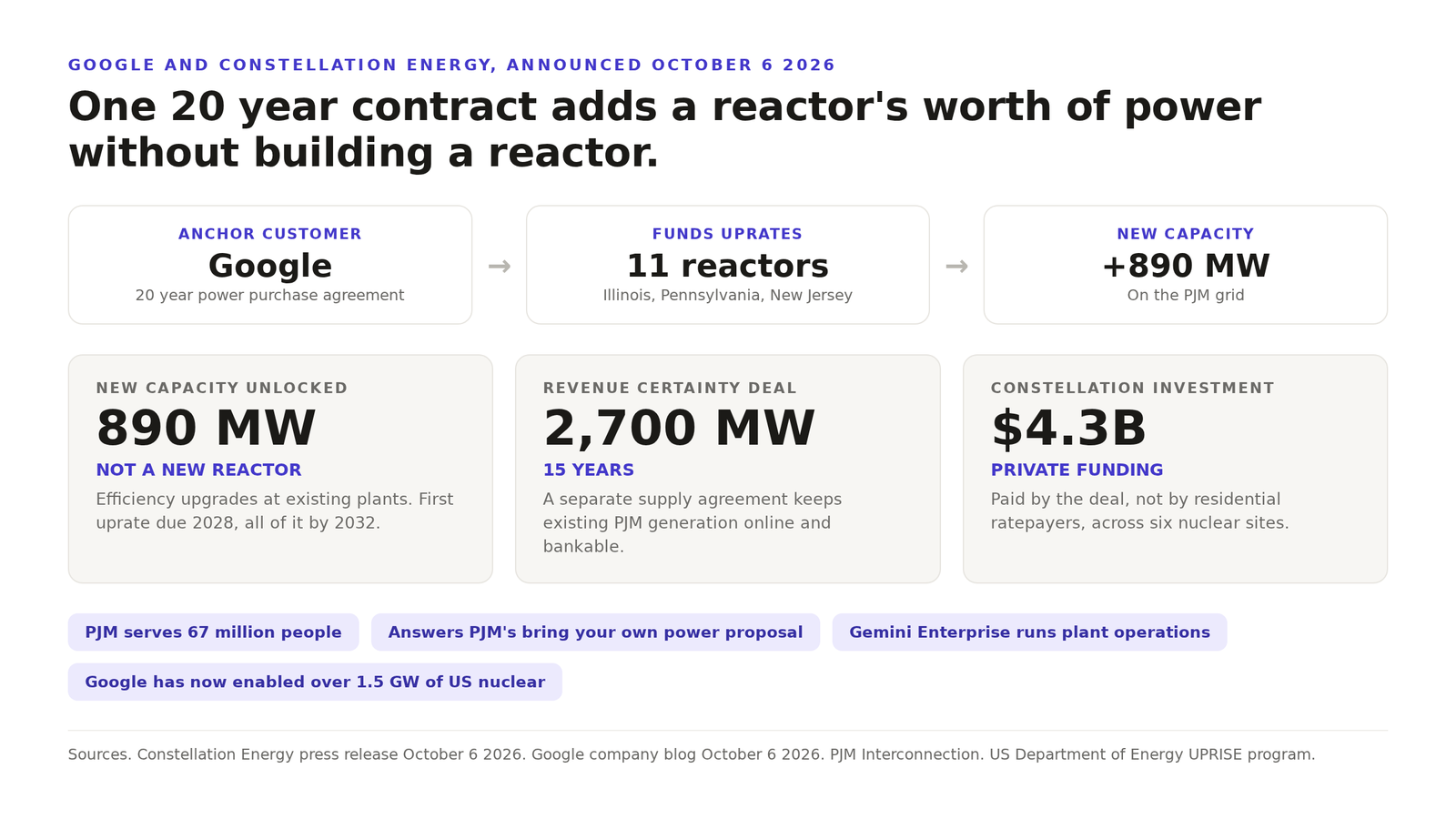
Google and Constellation Energy signed a 20 year nuclear power purchase agreement on October 6 that adds 890 megawatts of new capacity to the PJM grid without building a single new reactor. The megawatts come from uprates at 11 existing units in Illinois, Pennsylvania and New Jersey, where upgrades to turbines, steam generators and control systems raise output. The first uprate lands in 2028 and the full 890 megawatts arrive by 2032.
The finding is that the binding constraint on AI capacity has moved off the chip. It is firm power delivered on a schedule, and the fastest way to get it is to squeeze more out of plants that already exist. Constellation pays for the work itself, more than $4.3 billion, and a separate 15 year agreement keeps 2,700 megawatts of existing generation online and bankable. Google says it has now enabled over 1.5 gigawatts of new nuclear in the United States. Watch the delivery dates, not the headline megawatts.
Google did not order a reactor. It paid for an uprate, and that is the part every operator planning AI capacity should study.
The Constellation Energy contract funds upgrades at 11 existing reactors and unlocks 890 megawatts of firm, carbon free power on the PJM grid, which serves 67 million people. That is roughly the output of a large new reactor. It also arrives years sooner, because nobody has to license and pour a new one.
Constellation keeps the plants and pays for the upgrades itself. More than $4.3 billion of private investment lands across six nuclear sites in Illinois, Pennsylvania and New Jersey. The work sustains about 4,400 existing jobs and adds roughly 7,200 construction jobs while it runs.
An uprate buys time, not steel
A nuclear uprate modernizes turbines, steam generators and digital control systems to push more electricity out of a reactor that is already licensed and already connected. No interconnection queue. No greenfield site. The US Department of Energy runs a program called UPRISE for exactly this work, and it is why an uprate can ship in three years when a new reactor cannot.
The timeline is why the deal matters to anyone building AI capacity. A data center campus now takes two to three years to energize. A new reactor takes ten to fifteen. The two clocks do not line up. An uprate pulls the power clock closer to the construction clock.
Constellation carries the cost, and PJM ratepayers do not
The structure answers a fight building inside PJM, the largest US electric grid. The operator has proposed making the biggest new loads bring their own power or face curtailment during peak demand. The Google contract is a direct response. It adds supply to the system rather than just drawing on it.
The money is worth separating from the megawatts. The 890 megawatts are funded by a private company under a commercial contract, not through a rate case. Google and Constellation also signed a separate 15 year agreement covering 2,700 megawatts of existing generation, which keeps those plants economically viable without taking them off the grid.
The number to watch is the delivery date
Two of the three figures here are forecasts. The 890 megawatts do not exist yet. The first uprate is due in 2028, the same year a queue of other AI campuses expects its first power. Everything lands in the same two year window.
That is the pattern worth naming, because it repeats. Announced capacity is a forecast. Energized capacity is the product. Reuters reported the same package as a 3.6 gigawatt arrangement once the separate supply agreement is counted, and the honest read is that most of the headline number is still years from a meter.
Three questions to apply to your own environment. How much of your committed compute has firm power contracted to it with a date attached? If your largest power deal slipped by a year, what breaks first? And when a vendor sells you capacity, are they selling a signature or a switch?
Related reading. The same playbook showed up at Calvert Cliffs in September, where a 20 year deal bought a price hedge rather than a private power line. Oracle’s force majeure notice showed what happens when the power slips. And power procurement is now an IT budget line, not a facilities one.
Get the next one before it is old news
Independent analysis of cloud-native infrastructure, Kubernetes and data center economics. No vendor spin.