


Executive Summary
AWS charges more for reserved AI capacity from 7 October. EC2 Capacity Blocks for ML prices rise about 15 percent, the second such increase this year, and the top Blackwell tier lists at $16.146 per accelerator hour. On-Demand and Savings Plans pricing is unchanged. The increase lands while AWS is reported to be in talks to move roughly $8 billion of Grace Blackwell chips into a special purpose vehicle and lease them back.
The finding is that the GPU hour and the GPU itself are now priced in two separate markets. Rent is set by supply and demand for reserved capacity. Residual value is set by lenders and equity investors. AWS is managing both at once, lifting the tariff on the hour while shifting ownership of the asset to outside capital. Budget for the rate card and track who owns the silicon, because that is where the obsolescence risk now sits.
Reserved GPU capacity on AWS costs more from 7 October. The chip behind it may soon belong to somebody else.
AWS refreshed its EC2 Capacity Blocks for ML pricing page with new rates that take effect that day. Reporting puts the change at roughly 15 percent, and it follows a similar move in January, which makes this the second time this year the reservation price for the same class of accelerator has gone up.
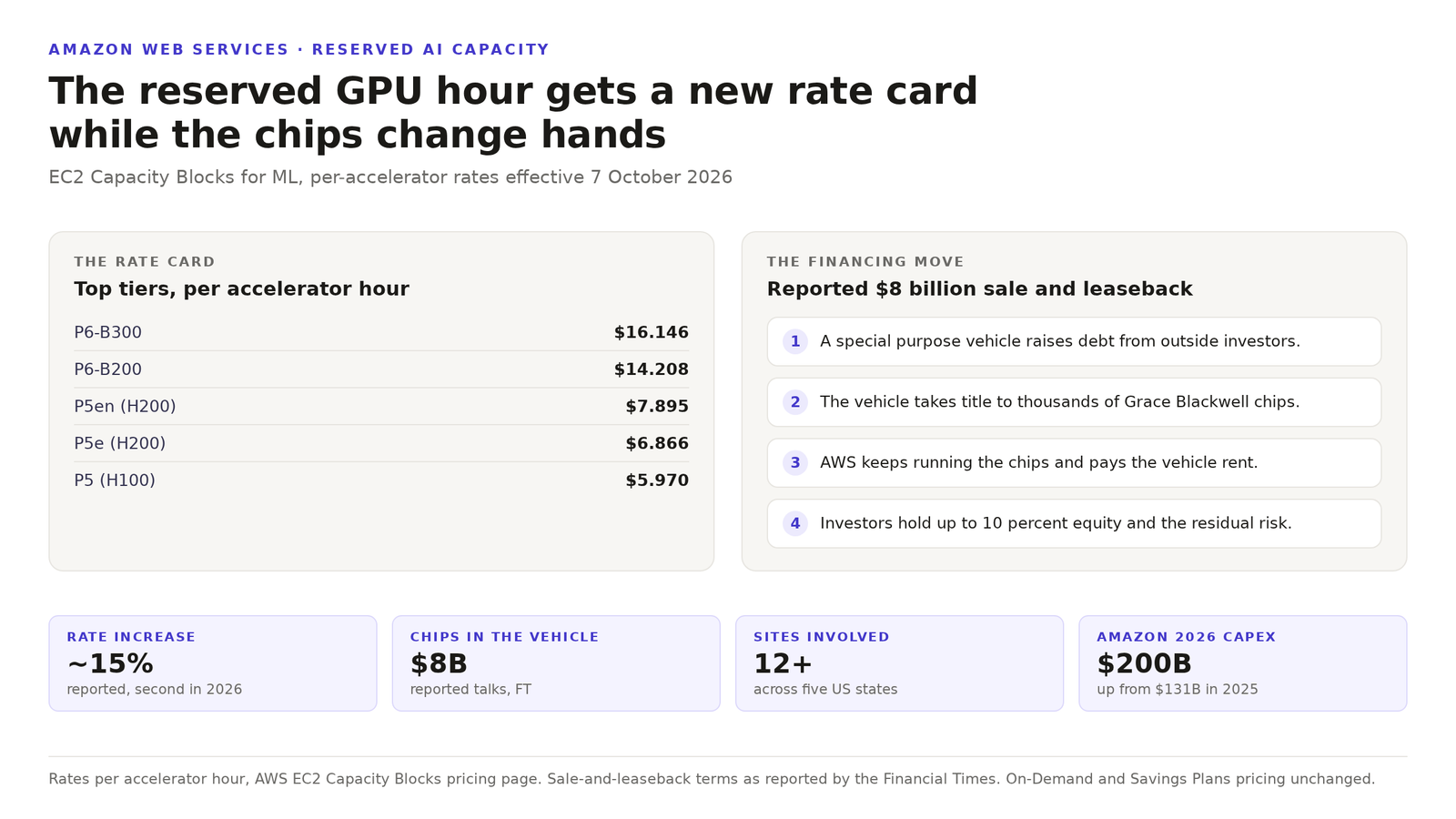
The rate card is short and blunt. P6-B300 lands at $16.146 per accelerator hour, P6-B200 at $14.208, P5en at $7.895, P5e at $6.866 and P5 at $5.970. Everything else, AWS says, including On-Demand and Savings Plans, stays put.
The reserved hour moved up, and the list moved with it
A capacity block is not spot capacity. You reserve a fixed window of accelerator capacity ahead of a training or inference run and pay up front for the guarantee. That guarantee is the thing AWS is repricing.
The pattern matters more than any single number. Rented accelerator capacity has climbed all year. Nebius lifted four on-demand tiers on 1 October, including a 21 percent step on its B300, in its second change in three months. AWS has now moved twice in the same window. The old instinct that a two-year-old part gets cheaper to rent does not hold.
The reason is structural. Newer accelerators carry more high-bandwidth memory, and memory has been the tightest input in the build. When the memory line rises, the rent for the whole rack rises with it, whatever the age of the silicon inside.
The same class of chips is moving off the balance sheet
In parallel, AWS is working the ownership side. The Financial Times reported that the company is talking to investors about placing about $8 billion of Grace Blackwell chips into a special purpose vehicle, then leasing them back.
The structure would work like an aircraft lease. The vehicle raises debt from outside investors, takes title to the hardware, and collects rent from AWS, which keeps running the chips in the same racks. AWS is reported to be considering an equity stake of up to 10 percent in the vehicle. The chips involved are already installed across more than a dozen US data centers in five states.
The context is the capex curve. Amazon set its 2026 capital spending near $200 billion, up from $131 billion in 2025, and has been borrowing against it, including a $17.5 billion term loan in June. Moving $8 billion of silicon off the books frees balance sheet room without touching the operating plan. The same reporting ties the price move and the financing move to one source of pressure.
Watch the rent and the residual separately
Put the two moves together and the shape of the market gets clearer. The GPU hour now trades like a utility tariff, set periodically against supply and demand. The GPU itself trades like a financed asset, with a residual value that lenders argue over. AWS sits on both sides, raising the tariff while handing the asset to investors.
That split changes who carries the risk. If a chip wears out economically faster than the lease assumes, the loss lands on the vehicle’s holders, not on the cloud operator. If reserved capacity stays scarce, the operator collects the higher rent either way. The AWS and Nvidia build-out keeps the supply side tight for now, so the rent is unlikely to fall back on its own.
Three questions are worth asking before you renew a compute commitment this quarter. Is your reserved rate locked for the full term, or does it reset when the list price changes? What is your duty cycle, given that a reserved hour bills whether the accelerator is busy or idle? And if the hardware is financed rather than bought outright, who holds the asset when the next part makes it cheaper to replace?
Related reading. We traced the same pressure across the rising GPU hour and the falling token price, and across what a rack now has to earn per megawatt.
Get the next one before it is old news
Independent analysis of cloud-native infrastructure, Kubernetes and data center economics. No vendor spin.