

Executive Summary
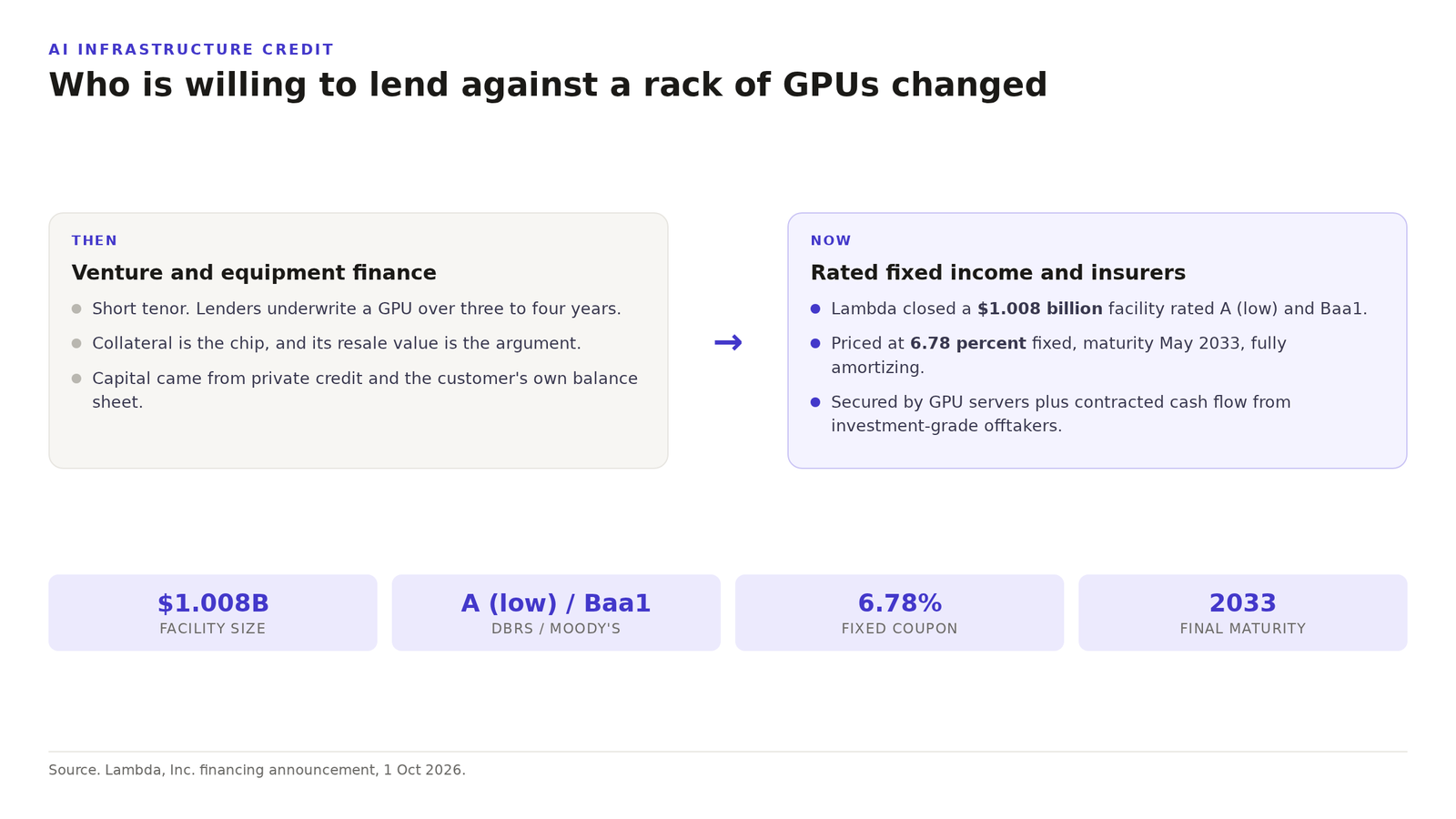
Lambda closed a $1.008 billion delayed-draw term loan on October 1, rated A (low) by Morningstar DBRS and Baa1 by Moody’s, at a 6.78 percent fixed rate. The loan is secured by the GPU servers it funds and by contracted cash flow from two investment-grade customers. It is the first GPU-backed debt deal of this size marketed to insurance companies and fixed income investors, and it was oversubscribed.
The finding is that the collateral question is being answered with contracts, not silicon. Lenders never bought the story that a processor holds most of its value for a decade. They bought the offtake agreements sitting on top of the servers. That is why the deal cleared at an investment-grade rating while the debate over GPU residual value runs on. AI compute is now underwritten the way a power plant is, on the strength of the customers who pay the bill.
The hardest money in the market just bought a rack of GPUs. On October 1, Lambda closed the facility and priced it inside its target range.
The mechanics are the story. The loan is a delayed draw, so money moves only as clusters come online. It matures in May 2033 and amortizes to zero over that life. It is secured by the servers and by the customer contracts behind them. Two investment-grade offtakers across three deployments carry the repayment.
The rating rides on the contracts, not the chips
This matters because the industry has spent a year arguing about how long a GPU is worth anything. Banks and credit managers underwrite a processor over three to four years. Nvidia points to valuation work that stretches a top-end system toward nine or ten. That gap is the whole residual value fight, and it decides how much debt can sit against a cluster.
Lambda sidestepped the fight. It did not sell lenders on the resale price of a chip. It sold them a stream of contracted payments from customers with strong credit. The chips are the asset. The contracts are the credit. When the two disagree, the contracts win.
GPU debt is now priced like infrastructure
Look at the sequence. Lambda raised roughly a billion dollars in each of its 2026 financings, first through a syndicated loan in August, now through fixed-rate paper for insurers. The August deal was the first broadly syndicated investment-grade term loan B from a private cloud provider. The October deal is the first of its size aimed at insurance and fixed income buyers.
Each step pulls AI compute further into the same capital markets that fund pipelines, ports and power stations. Those buyers do not chase multiples. They want a rating, a coupon and a maturity, and they hold to it. When they show up, a business stops being a venture bet and starts being collateral. Moody’s and the other agencies are now in the room for every large GPU deal. The capacity that money funds keeps growing, and Epoch AI tracks the pipeline.
What it means if you run the cluster
If debt is now rated on offtake, then who you sell to matters more than what you buy. A startup with a great fleet and no contracted customer will pay more for capital than a developer with a plain fleet and a signed anchor tenant. The financing cost follows the contract book.
The other change is discipline. A facility that amortizes to 2033 assumes the cluster earns for seven years. If your model assumed a shorter life and an early refresh, the lenders are now holding you to the longer one in public. Your depreciation schedule and your loan schedule are the same argument.
Three questions for your own fleet. Who is your investment-grade offtaker, and is that contract assignable to a lender? Does your refresh plan match the amortization on any debt against it? And if you cannot get a rating, can you still fund the next rack from your own balance sheet?
Related reading. The price of that compute is moving too. GPU rental rates are climbing while the token price is not. That analysis is here. And Anthropic’s filing shows what a decade of contracted compute looks like on a balance sheet. Read it here.
Get the next one before it is old news
Independent analysis of cloud-native infrastructure, Kubernetes and data center economics. No vendor spin.