

Executive Summary
HPE’s first commercial AMD Helios order is worth $1.2 billion from Vultr, and the number that matters is not the dollars. Each rack carries six Juniper switch trays that connect all 72 AMD Instinct MI455X GPUs over Ethernet, using the UALink over Ethernet standard. That puts HPE networking hardware inside the scale-up domain, the tightly coupled fabric between GPUs that Nvidia has held with NVLink.
The finding is that rack-scale fabric is no longer one vendor’s private road. An open Ethernet scale-up path now has a shipping integrator, a standards body behind it, and a neocloud willing to spend nine figures on it. HPE raised its data center networking outlook to a low-to-high 50s percent compound rate through fiscal 2029 the same day, and lifted its Juniper cost-savings target to $800 million. The verdict for buyers is that compute, fabric and cooling are becoming separable line items.
Vultr just handed HPE $1.2 billion for AI racks. It is HPE’s first order for the AMD Helios AI rack, and Vultr will run it in US data centers. Read the release closely and the money is the least interesting line.
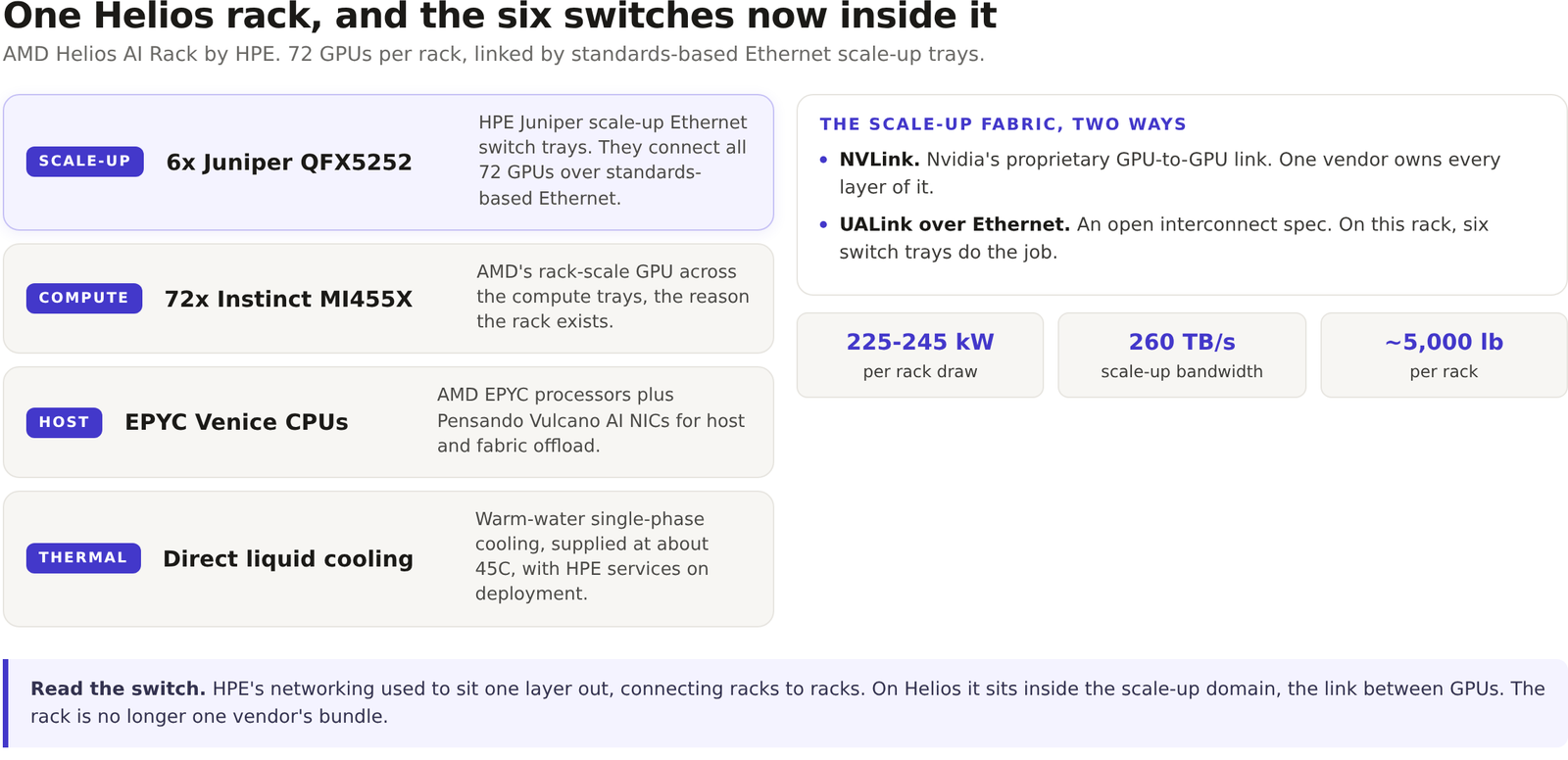
AMD designed Helios as one rack that trains trillion-parameter models and serves high-volume inference. Every rack holds 72 AMD Instinct MI455X GPUs, AMD EPYC Venice CPUs, AMD Pensando Vulcano AI NICs, and the ROCm software stack. The design follows Open Compute Project specifications for power delivery, liquid cooling and serviceability. The unit draws between 225 and 245 kilowatts and weighs around 5,000 pounds. That is the compute. The part that decides who gets paid is how the 72 GPUs talk to each other.
HPE stopped selling the rack and started selling the fabric inside it
For years, HPE networking lived one layer out. Juniper switches connected racks to racks and clusters to data centers. That layer matters, but it sits apart from the hardest problem, which is the scale-up fabric. Scale-up is the high-bandwidth road between GPUs inside a single rack. Nvidia owns it with NVLink.
HPE just bought a seat on that road. Each Helios rack carries six HPE Juniper Networking QFX5252 scale-up Ethernet switch trays. Those trays connect all 72 GPUs over standards-based Ethernet. HPE is no longer a vendor standing beside the AI rack. It is a component inside it, and its revenue scales with the rack, not with the data hall around it.
AMD finally has a reference customer for rack scale
A rack-scale platform lives on proof. AMD has shown Helios and shipped the specifications, but a design that nobody deploys is a slide deck. Vultr is a neocloud that resells GPU capacity, and it committed nine figures to Helios across US facilities. That is a commercial reference AMD can put in front of the next buyer without footnotes.
The standards angle is quieter and larger. The fabric uses UALink over Ethernet, an open interconnect specification the industry built partly to avoid a single vendor’s proprietary scale-up link. Ethernet scale-up has been promised for two years. This is the first order carrying a number that size.
The open fabric is the part to watch
HPE raised its networking outlook the same day. Data Center Networking is now guided to grow at a low-to-high 50s percent compound rate through fiscal 2029, and the Juniper cost-savings target moved from at least $600 million to $800 million by the end of fiscal 2028. Those targets assume scale-up switching keeps growing. The Vultr order is the first commercial proof that it can.
For operators, the practical question is whether an open Ethernet fabric changes procurement. If it holds, a rack stops being one vendor’s bundle. Compute, fabric and cooling become separable line items, and the buyer can mix suppliers on each. That is the same unbundling that broke the proprietary storage array. AMD also needs its ROCm software to harden, because every production Helios deployment gives it a real workload to face. One order does not prove a market. But the switch has moved inside the rack, and the rack is now open.
Three questions for your own stack. Does your scale-up fabric lock your GPUs to one vendor’s interconnect. If you buy Ethernet scale-up, who carries the support boundary when compute and fabric come from two companies. And on your next AI capacity order, is the network priced inside the rack or billed as its own scaling decision.
Related reading. The GPU cluster now spans two data centers, not one, and NVIDIA open sourced the cluster map Kubernetes schedulers never had.
Get the next one before it is old news
Independent analysis of cloud-native infrastructure, Kubernetes and data center economics. No vendor spin.