
Executive Summary
AMD agreed on September 28 to buy World Labs, the spatial-intelligence lab co-founded by Fei-Fei Li, for about 8.2 billion dollars in stock. Li becomes AMD’s executive vice president and chief scientist, reporting to Lisa Su, and the deal is AMD’s second largest ever. The lab keeps doing model research after the deal closes by the end of 2026.
The finding is that a chip designer has decided it cannot design the accelerators that come next without owning the team that builds the models they will run. Nvidia did the same thing when it agreed to buy Hugging Face for 12.93 billion dollars earlier in September. AMD is buying a roadmap input, not a product line. The gap it does not close is software, where ROCm still trails CUDA, and that is what decides whether an AI team writes for AMD silicon.
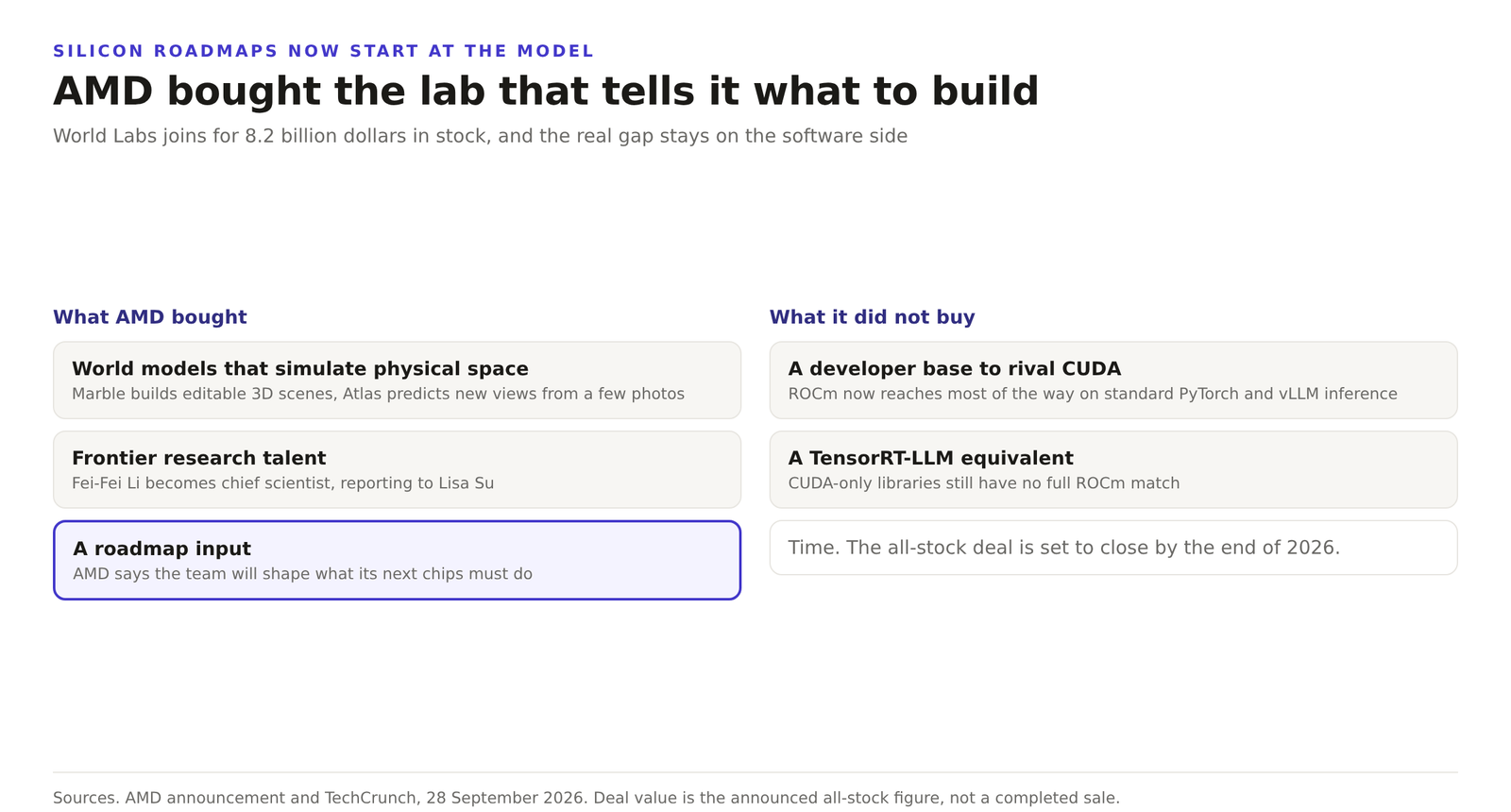
AMD has spent three years assembling an AI stack through acquisitions. On September 28 it added the part that tells it what to build, agreeing to buy World Labs for about 8.2 billion dollars in stock.
AMD frames the purchase as insight rather than product. World Labs builds world models, systems that reconstruct and simulate three-dimensional space from text, images and video. Its first product, Marble, turns a prompt into an editable 3D scene, and a newer model, Atlas, predicts fresh camera views from a handful of photos.
{FIGB}
AMD bought an input to its roadmap, not a product line
Read AMD’s own explanation and the deal looks less like a product bet than a planning one. The company says World Labs will give it a deeper view of how AI workloads are changing and help shape its future roadmaps. That is an input to chip design. It is not revenue.
Li will be AMD’s chief scientist, and her team keeps doing research after the close. That is the same shape as Nvidia’s 12.93 billion dollar deal for Hugging Face, agreed earlier in September. Both chipmakers want the people who define what the next workloads look like inside their own walls, before those workloads arrive.
If the frontier is moving from text toward reasoning, robotics and simulation, then the company that understands the new models gets to design the silicon that runs them. AMD has had almost none of that research in house until now.
The gap AMD did not buy is the software one
A model-research team does not fix a developer-tools problem, and that gap is the one that decides adoption. CUDA spans millions of developers and years of accelerated libraries. ROCm has closed a lot of ground, and on standard PyTorch and vLLM inference it now reaches most of the way to Nvidia’s throughput.
It still breaks where code depends on libraries CUDA owns. TensorRT-LLM and FlashAttention 3 have no full ROCm equivalent, and on those workloads the gap widens sharply. Buying a world-model lab changes what AMD knows about the future. It does not change what a developer can run this afternoon.
The cost difference is real, and it is why AMD silicon keeps winning memory-bound work. More GPU memory per card matters when a model’s weights and its cache have to sit side by side. The blocker is not the hardware. It is the migration cost a team pays in tooling and rewrites.
What to watch as the deal moves through review
Two things decide how this lands. The first is whether the research team keeps the freedom that made it worth buying, because a lab absorbed into a chip roadmap can lose the habit of asking its own questions. The second is the software roadmap, whether AMD ships the libraries that make ROCm a default rather than a fallback.
Three questions for a buyer weighing AMD silicon. Does your stack depend on TensorRT-LLM or FlashAttention 3. Can your team absorb the install and tooling overhead ROCm still asks for. And does your volume justify the cost difference that ROCm offers today.
Related reading. We covered Anthropic’s 11.6 billion dollar commitment to CPUs and why token prices fell while the cache took on the bill.
Get the next one before it is old news
Independent analysis of cloud-native infrastructure, Kubernetes and data center economics. No vendor spin.