


Executive Summary
Reuters reviewed Anthropic’s IPO prospectus and found a company growing fast and spending faster. Revenue rose twelvefold in 2025 to nearly $4.6 billion, but compute and infrastructure took $7.33 billion of $12.65 billion in operating expense, more than half of everything the company spent. The headline net loss of about $42 billion is dominated by a roughly $34 billion non-cash accounting charge, not cash leaving the building.
The number that decides the story is not on the income statement. Anthropic carries $518 billion in forward cloud, compute and infrastructure obligations, and the reporting says much of that book is committed rather than optional. The company is underwriting a decade of capacity ahead of the revenue to pay for it. The same shape now shows up from Nvidia’s lease guarantees to battery-backed AI factories. Cheap tokens are a capital structure decision before they are a product feature, and this filing makes the bet legible.
The prospectus shows a company that spends most of its money on the machines that run the model. Reuters, which reviewed the filing, put the 2025 compute and infrastructure line at $7.33 billion, close to three times the 2024 figure and the largest single item on the expense side.
That is the clearest signal yet of where the AI economy actually sends its money. Not to the sales team, and not to the model weights. To power, accelerators, and the buildings that hold them. Anyone planning an AI budget for next year is really planning a capacity budget.
Compute is now more than half of operating expense
Total operating expenses reached $12.65 billion, and compute and infrastructure was $7.33 billion of that, roughly 58 percent. Revenue grew twelvefold to nearly $4.6 billion. Anthropic submitted a confidential draft registration in June and has not published the document itself, so every figure here comes from the Reuters review and the reporting that followed it.
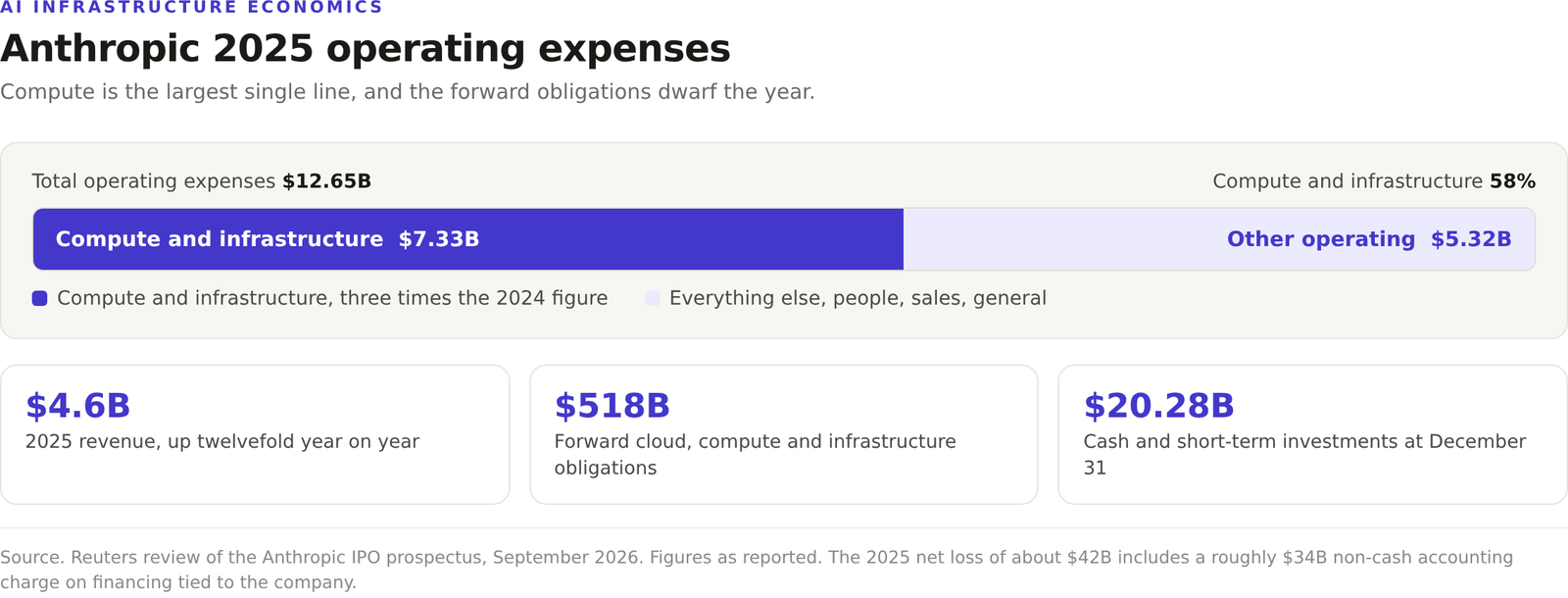
Read the loss carefully, because the headline number misleads. The net loss of about $42 billion includes roughly $34 billion that is an accounting charge on financing that could convert into shares. The operating loss was closer to $8 billion. The company held $20.28 billion in cash at the end of the year. This is not a business burning $42 billion a year in the ordinary sense.
The compute line is a different matter. It tripled in a single year, and the same document carries a concentration risk that sits underneath it. Nearly a quarter of 2025 revenue came from two customers, and the filing warns that many large clients are not locked into long term contracts.
The $518 billion forward book is the real bet
The obligations number is the one to sit with. Anthropic plans to spend $518 billion on cloud, compute and infrastructure in the coming years, and Reuters follow up reporting says a large share of that sits in commitments that cannot be canceled. That is capacity bought before the demand that would pay for it is proven.
This is now the standard financing shape of AI infrastructure. Nvidia has underwritten the residual value of OpenAI tenanted data center leases in Ohio. Anthropic has signed direct gigawatt scale leases of its own. The contract, not the chip order, is what proves the build, because the hardware arrives on a schedule whether or not the tokens get sold.
For an operator, the interesting consequence is that these commitments set a floor under future token prices. Committed capacity wants to be filled, and a provider with $518 billion of it will chase utilisation hard.
Cheap tokens are a balance sheet problem
Every provider funding capacity this way needs the same thing, which is volume at a price that covers the depreciation. That is why the token price war of the past year looks less like a marketing fight and more like a debt service obligation. The economics of the filing are the economics of every large inference provider, just stated in public for the first time.
The practical lever inside a buyer’s control is utilisation. A reservation that runs at 40 percent wastes more than a reservation priced 20 percent higher that runs at 80. Cache hit rates, batching, and the mix of prefill to decode decide what a token actually costs, which is the argument behind our token price and cache analysis. Anthropic’s own CPU heavy deal with Akamai shows the same logic, that not every stage of an agent belongs on an expensive accelerator.
Three questions for anyone whose AI budget touches committed capacity. What share of your reserved compute maps to demand you can actually forecast? Who carries the residual if that demand undershoots? And what does your cheapest token cost at the utilisation you really run, not the one on the slide?
Get the next one before it is old news
Independent analysis of cloud-native infrastructure, Kubernetes and data center economics. No vendor spin.
[…] Related reading. For the rental market this contract prices, see our look at GPU rental prices and token economics. For who ultimately pays the compute bill, see Anthropic and the infrastructure obligations behind its numbers. […]