
Executive Summary
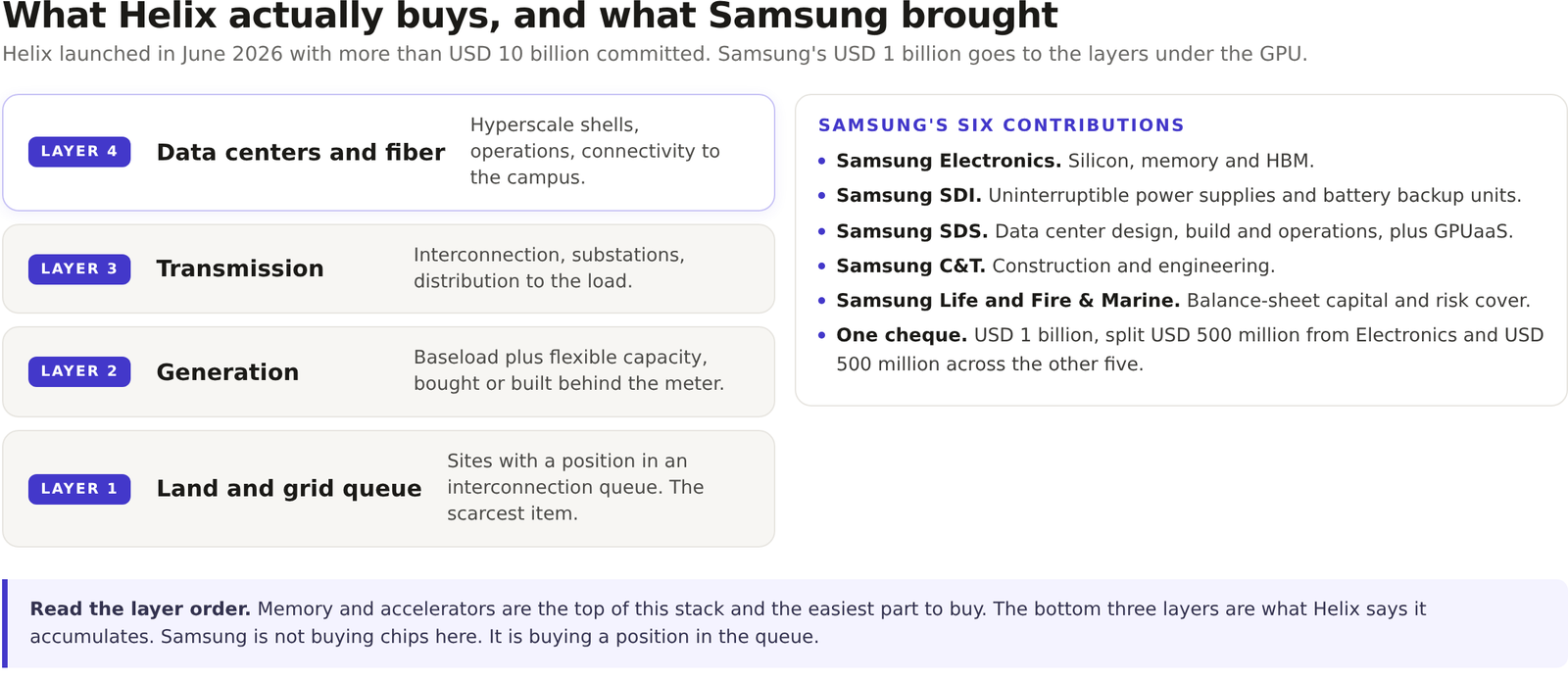
Six Samsung entities committed USD 1 billion to Helix Digital Infrastructure on 29 September. Samsung Electronics took USD 500 million. Samsung C&T, Samsung SDS, Samsung SDI, Samsung Life Insurance and Samsung Fire & Marine Insurance split the balance. Helix is a KKR company launched in June 2026 with more than USD 10 billion already committed, run by Adam Selipsky, the former AWS chief executive, with Nvidia, the Kuwait Investment Authority and Vistra as founding investors.
The finding is that the scarce money in AI has left the accelerator and moved to the four layers under it, and Samsung is buying all four in one transaction. Power availability is the bottleneck, in Samsung’s own framing, so securing compute and power together is the advantage. Samsung SDI supplies uninterruptible power and battery backup. Samsung SDS builds and runs the halls. Samsung C&T builds the shells. The memory cycle pays for the position. The position is the grid, and it is measured in queue years, not chips.
Helix is not a data center company. It is a queue position with a balance sheet attached. The company buys land, generation, transmission and fiber, then hands a finished campus to a hyperscaler. The September cheque is Samsung buying a seat at the front of that queue.
The bottleneck moved off the silicon and into the substation
Nvidia sells the accelerator. It does not sell the interconnection. A 1 gigawatt campus needs a position in a utility queue that can take five to seven years to clear, transmission that may not exist yet, and water for cooling. Those are the items Helix is accumulating, and they are the items that set the delivery date.
This is the same constraint that reshaped the battery market. Our analysis of why AI factories now buy the battery before the chip made the point that the power chain, not the GPU, decides when capacity turns on. Helix has now industrialised that argument. Its stated plan is to secure energy capacity through direct investment and partnerships with energy developers, and it named its own founding investor Vistra as one of them.
That is why Samsung’s money is interesting and Samsung’s silicon is not. The claim is not that chips stopped mattering. The claim is that a chip order takes a quarter and an interconnection position takes years, so the capital that knows the difference is going where the clock is longest.
Samsung SDI sells the part that keeps the rack alive
The least glamorous of the six participants is the most revealing. Samsung SDI makes uninterruptible power supplies and battery backup units. Those are the components that ride out the gap between a grid fault and a generator start, and at rack densities above 100 kilowatts that gap is measured in milliseconds and millions of dollars of interrupted training.
The claim is not that batteries are new. The claim is that battery and UPS procurement has moved from a facilities line item to a condition of the compute contract. A hyperscaler leasing a campus will not sign against a grid connection that has no ride-through. Samsung SDI sits on the part of the deal that has to be true before the GPUs arrive.
Samsung SDS covers the other end. It designs, builds and operates data centers, has moved into GPU-as-a-service, and claims the lowest power usage effectiveness in Korea, which it applies to the Korea AI Computing Center. Samsung C&T brings the construction. Samsung Life Insurance and Samsung Fire & Marine Insurance bring capital and risk cover. Six entities, one integrated bid.
Korea is buying into a bottleneck it cannot build at home
Samsung’s own statement is the tell. It says power availability is the greatest bottleneck in AI infrastructure, and that securing compute and power at the same time has become a defining advantage. A conglomerate that makes HBM, panels, batteries, insurance and construction has just decided that the scarce layer is none of those and all of them at once.
The awkward part is that Helix is a US company with US and European sites. Korea is not buying domestic capacity with this cheque. It is buying an equity position in other countries’ wiring, which is a reasonable hedge and a difficult political story at home.
Three questions for your own environment. Who in your organization owns the interconnection queue, and is it the same person who owns the compute roadmap. If your 2028 capacity plan assumes a delivery date, what is the power source for that date. And if your accelerator vendor is now also your financier, who prices the residual value of the hardware when the lease ends.
Related reading. NVIDIA certified the batteries, and Memphis shows why covers the certification side of the same shift, and Washington is buying 23 gigawatts out of wires already in the ground covers the grid side.
Get the next one before it is old news
Independent analysis of cloud-native infrastructure, Kubernetes and data center economics. No vendor spin.