


Executive Summary
Akamai’s $11.6 billion contract with Anthropic is the largest in the company’s history, and the first time Akamai has attached an equity warrant to a cloud deal. The warrant covers up to about 5 percent of Akamai and vests as Anthropic spends more, so the supplier now profits when its own customer grows.
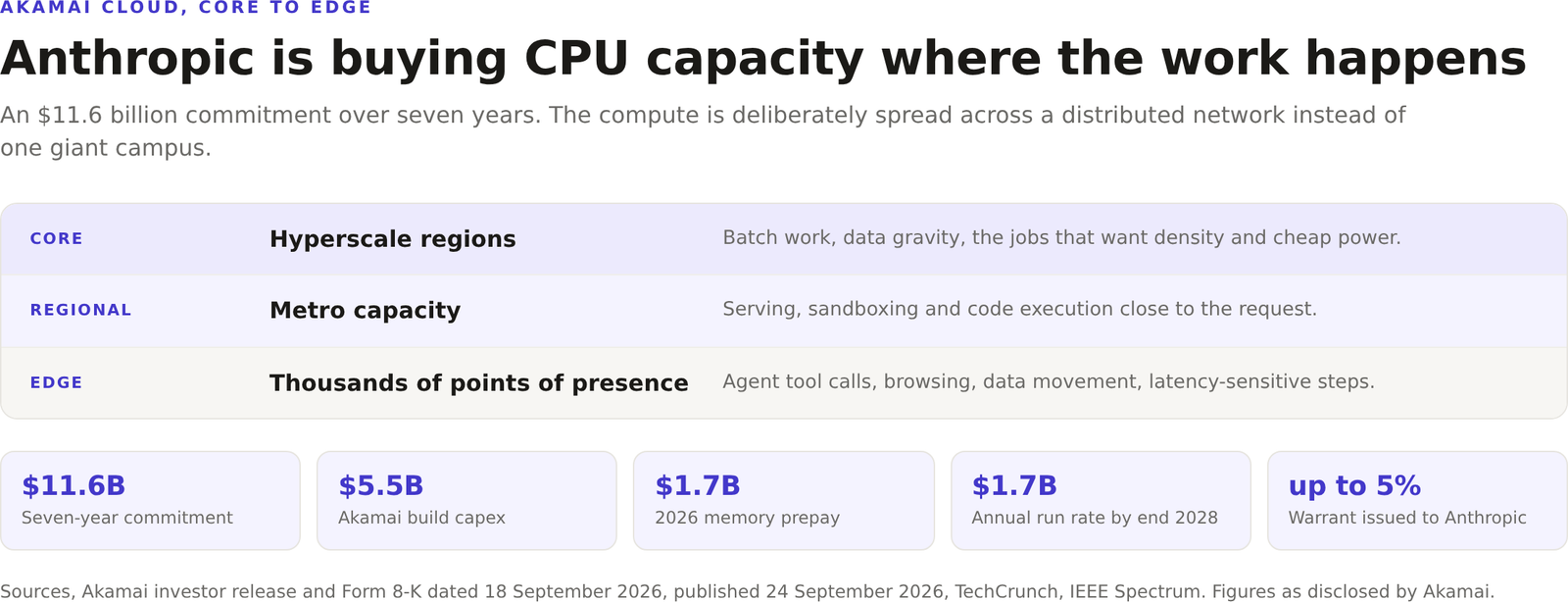
The workload is the part worth reading. Akamai describes the demand as CPU capacity, the general-purpose compute that agentic systems consume on tool calls, code execution and data movement, not the GPUs the rest of the industry counts. Akamai will spend about $5.5 billion to build it and prepay memory, sees no revenue before the second half of 2027, and expects roughly $1.7 billion a year by the end of 2028. Delivery and service levels are conditions on the commitment, so the headline total is a ceiling rather than a receipt.
Anthropic has spent the year assembling compute from anyone willing to sell it. The Anthropic Akamai deal is the newest stop, a seven-year commitment worth $11.6 billion for CPU capacity that arrives from a distributed network instead of one campus.
Akamai spent two decades running a content delivery network, thousands of points of presence built to push web content closer to users. It has since turned that footprint into a distributed cloud. The pitch never changed. Keep the work near where it happens rather than hauling everything to a single site. Anthropic is buying into that shape on purpose, and it is buying the least fashionable layer of it.
The deal arrived with a warrant that grows
Akamai issued Anthropic a warrant for up to roughly 5 percent of its stock at $111.33 a share. About 2 percent vests on the first committed payment. The rest vests in steps, close to one more percent for every additional $3 billion Anthropic spends, up to a further $9 billion. That takes the potential total to about $20 billion. The Next Web reported it is the first warrant Akamai has attached to a cloud deal.
It inverts the circular structure the market has grown used to. Normally a chipmaker or a cloud provider takes a stake in the lab that buys its product. Here the supplier hands its customer the upside, then ties the vesting schedule to more spending. A vendor that holds a slice of its buyer does not behave the same way when the buyer slows down, and the ladder gives Anthropic a reason to keep steering new commitments to the partner that shares its upside.
Anthropic is buying the compute agents actually burn
Akamai framed the commitment around CPU workloads, which stands out in a market that counts GPUs. CPUs are the general-purpose chips that run code, drive a browser, call a tool and move data between services. The longer an agent runs without a human watching, the more of its machine time goes to exactly that work. IEEE Spectrum has tracked the resulting pull back toward the CPU.
Dense GPU regions are built for training and high throughput serving. Distributed CPU capacity is built for the messy work around the model, the sandboxing, the retrieval, the orchestration and the tool calls. That is the half of an agent platform that scales with the number of concurrent jobs rather than with model size, and it is the half most operators under-provision.
The economics are lumpy. Akamai expects about $5.5 billion in capital spending to stand the capacity up, and it is adding roughly $1.7 billion to 2026 capex to pre-buy memory and other components. Revenue arrives late. Akamai guided $150 million to $300 million in 2027, all in the second half, then a run rate near $1.7 billion a year by the end of 2028.
The commitment is conditional, so read it as a ceiling
The $11.6 billion depends on Akamai hitting delivery and service availability targets, and either side can walk under stated conditions. That is normal at this size, and it matters to anyone treating the figure as booked revenue. TechCrunch flagged the condition, and the same structure appears in Anthropic’s $45 billion arrangement with Nscale.
Anthropic has now spread its compute across Amazon, Google, Microsoft, AMD, Nscale and a gigawatt-scale campus lease from Stream Data Centers. Akamai is the newest lane, and the only one framed as mostly CPU. Each deal is written so the lab can expand without renegotiating from scratch, which is why the headlines keep arriving in the same shape.
What to watch. The open question is whether CPU capacity delivered from thousands of edge locations can beat dense, purpose-built regions on cost per token. If it can, the GPU monoculture gets a second front.
Three questions for your own estate. Where does your agent workload actually spend its machine time, on the accelerator or on the general-purpose chip beside it? Would a distributed footprint serve that work more cheaply than one region? And if your largest supplier handed your biggest vendor an equity stake, would your negotiating position change?
Related reading. Anthropic would rather lease the building than rent the cloud covers the gigawatt lease. Enterprise AI Infrastructure Runs on Four Layers explains the stack this capacity sits inside.
Get the next one before it is old news
Independent analysis of cloud-native infrastructure, Kubernetes and data center economics. No vendor spin.
[…] reading. We covered Anthropic’s other compute deal, an 11.6 billion dollar bet on CPUs rather than GPUs, and the deauthorization of one of Broadcom’s own top VMware […]
[…] reading. Akamai and Anthropic’s CPU capacity deal and Anthropic and Akamai’s CPU workloads for AI […]