
Executive Summary
Host configuration is the part of a GPU cluster nobody manages declaratively. Kernel parameters, driver builds, security agents and CVE patches still live in playbooks and runbooks, applied one node at a time. That works until a training run spans two hundred nodes and a kernel update has to land on all of them at once.
NodeWright attacks that gap. Released as open source after years of internal use at NVIDIA under the name Skyhook, it treats the fleet as the unit of change. It cordons, waits, drains, applies, interrupts and uncordons each node in sequence, and it respects the disruption budgets and protected-workload labels a scheduler already understands. The finding is that the host layer was the last part of the AI stack still managed by hand. The verdict is that this is less a new product than an admission, and the thing underneath the GPU Operator has been the weakest link in production AI infrastructure for years.
NVIDIA open sourced NodeWright this week, a Kubernetes-native tool that configures and updates the host operating system underneath GPU workloads. It ran inside the company for years under the name Skyhook. The rename is minor. The problem it points at is not.
GPU nodes are not disposable. A misbehaving cloud instance can be replaced in minutes. A GPU node cannot, because the hardware is scarce and the training job on it may have been running for weeks. That constraint is why host maintenance on AI clusters has been stuck with a spreadsheet, a maintenance window, and an engineer watching a terminal at 3 a.m.
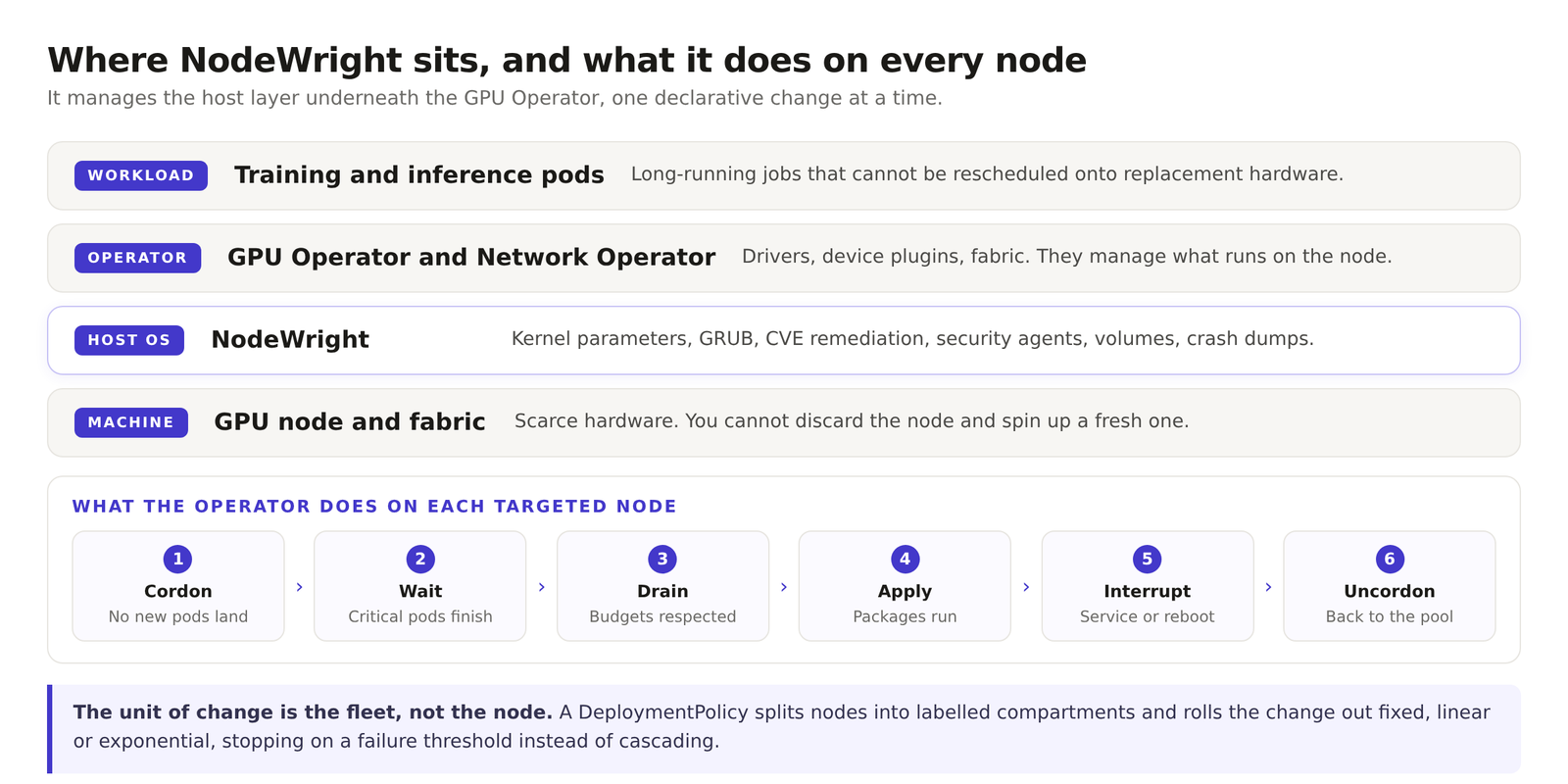
NodeWright replaces that with a declarative model. You describe the change as a custom resource, target nodes by label, and an operator walks each node through a fixed sequence. The NVIDIA technical blog draws the line clearly. The unit of change is the fleet, not the node.
The host layer was the last thing still managed by hand
Ansible and Puppet were built for a world where machines are managed one at a time, not as members of a cluster running sensitive workloads. Neither will cordon a node, wait for a critical pod to finish, drain workloads before a reboot, or report the result back into the cluster where your observability already lives.
NodeWright closes that gap. Its packages are container images that carry the real changes, and they ship with verification steps that surface a failure instead of hiding it. A package can set sysctl and GRUB parameters, create logical volumes, install security agents, and remediate a CVE. If a vulnerable kernel module survives the change, the package reports failed.
The scope line matters as much as the feature list. NodeWright does not replace the GPU Operator or the Network Operator. It manages the host OS layer underneath them, one project inside DSX OS alongside Topograph and the DRA driver for NVIDIA GPUs.
The unit of change moves from the node to the fleet
There are three moving parts. An operator is a controller that watches the custom resources. Packages are the container images that do the work. Custom resources are how you declare what you want, and they deploy through kubectl, Helm, Argo CD or Flux.
The rollout logic is where the design earns its keep. A DeploymentPolicy splits nodes into named compartments by label, each with its own disruption budget and strategy. Fixed updates a constant batch. Linear grows the batch by a fixed delta. Exponential doubles it, starting at one node. Each batch carries a success threshold before the next one starts, and an optional failure threshold stops that compartment rather than letting the change cascade.
New capacity benefits too. A freshly provisioned GPU node can be required to join the cluster tainted, run its packages and pass validation, and only then be untainted. That keeps new nodes from accepting production work before they are ready. Teams running validated driver, kernel and operator combinations can pull those recipes from NVIDIA AI Cluster Runtime and let NodeWright apply the host half.
What to ask before you rip out your playbooks
Nobody should delete Ansible tomorrow. NodeWright is early, and it is one piece of a larger portfolio. The signal is about category, not vendor. The host layer is being reclassified as part of the platform rather than an operational chore, and that is overdue on any cluster where a node costs more than a car.
Three questions worth answering this week. Can you name every host level change your GPU fleet received last quarter, and which nodes got it? If a CVE landed tomorrow against your kernel, how would you know which nodes were remediated? And if a node dropped out of a two hundred node training run for twenty minutes, what would that cost in GPU hours? If the honest answer is a spreadsheet, this project is worth an afternoon.
Related reading. NVIDIA Topograph targets the same fleet problem one layer up, by mapping GPU topology so schedulers stop placing work across the wrong links. Enterprise AI infrastructure runs on four layers, and the host and runtime layer is where quiet failures live. Pod disruption budgets are the primitive NodeWright respects by default.
Get the next one before it is old news
Independent analysis of cloud-native infrastructure, Kubernetes and data center economics. No vendor spin.
[…] Read the full analysis […]