

Executive Summary
The 2026 grid matters for what it no longer shows. A category that once described one dominant product has fragmented into a Leader set spanning an HCI incumbent, a Kubernetes platform and the incumbent itself, with a crowded middle of Challengers and Visionaries beneath. Gartner projects that by 2028 cost concerns will push 70 percent of enterprise VMware customers to move half their virtual workloads elsewhere, and it frames that as fragmentation rather than a straight swap.
For buyers, placement now answers one question and no others. It tells you who is credible enough to shortlist. It says nothing about your three year cost, your migration timeline or your support terms, and one vendor in this report is selling a timeline guarantee precisely because that is what buyers fear. Shortlist from the grid, then decide on your own numbers.
The analyst grid that used to be a formality now reads like a shopping list. The Gartner Magic Quadrant for Server Virtualization Platforms landed on 14 September. Within days, every vendor in the category pushed out a release claiming vindication.
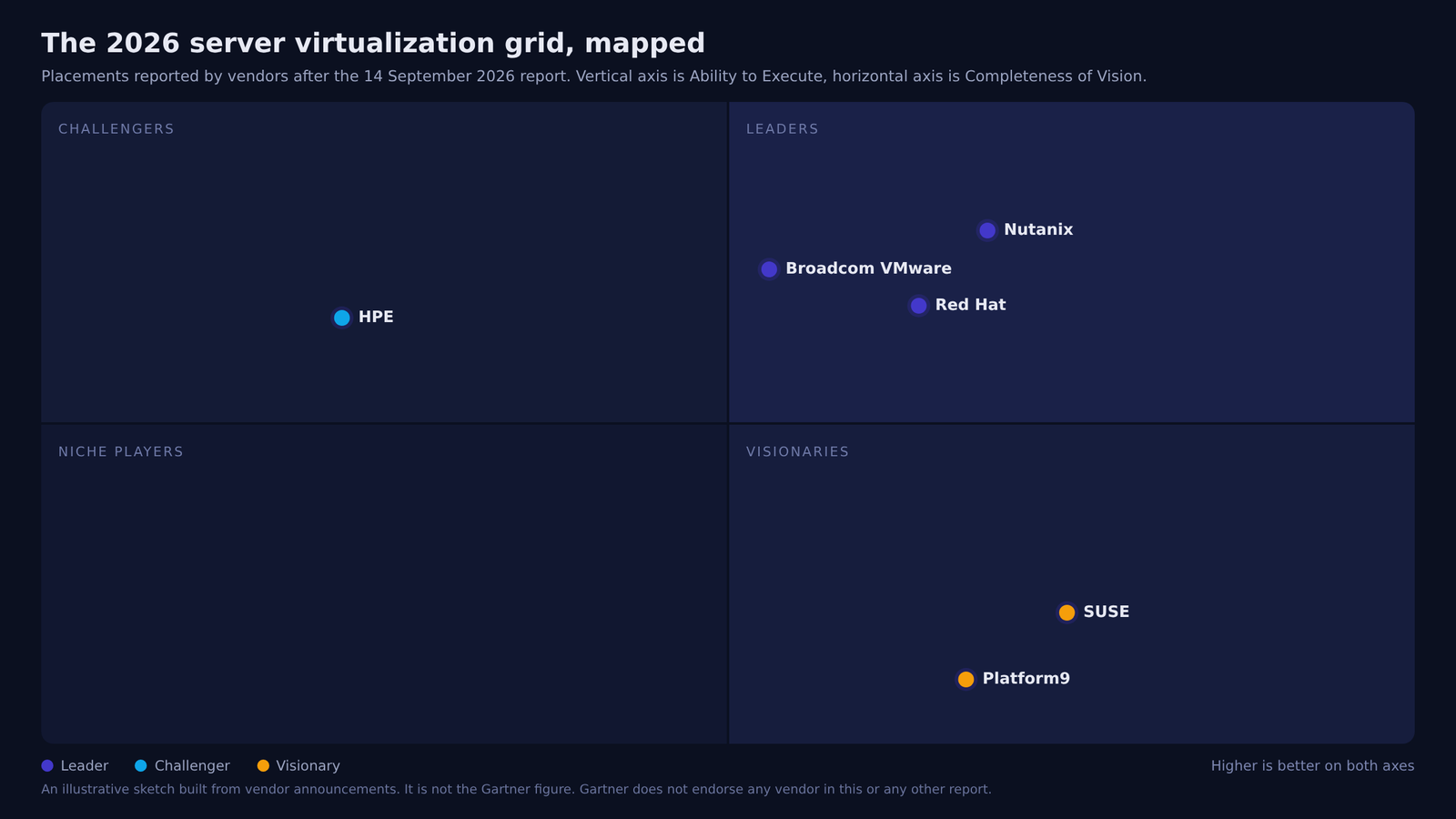
That part is routine. What is not routine is the shape of the market underneath the grid. A quadrant that once described one dominant product and a handful of also-rans now has to sort between an HCI incumbent, a Kubernetes platform, a hardware vendor, and two private-cloud specialists. All of them are chasing the same displaced VMware estate.
The grid finally reflects the revolt
Gartner’s own language has changed. The firm has written that Broadcom’s takeover of VMware reignited competition in server virtualization, driven by customer worries about total cost of ownership, support quality, and roadmap changes. That is a polite way of saying the incumbent lost trust, and the analyst firm had to score the fallout.
The report is credited to Tony Harvey, Daniel Bowers, Paul Delory, Tony Iams and Owen Marino. Gartner published a Critical Capabilities companion the same day. Neither document endorses a vendor, and Gartner says so in its standard disclaimer. Treat the grid as an input, not a verdict.
Two numbers from Gartner’s recent market research explain why this grid got crowded. The firm has projected that by 2028 cost concerns will push 70 percent of enterprise VMware customers to move half of their virtual workloads somewhere else. It has also described the shift as fragmentation rather than a straight swap. When one base splits across many buyers, more vendors can look credible at the same time. That is what this quadrant shows.
Who showed up, and what each placement means
Nutanix said it was named a Leader and placed highest on the Ability to Execute axis. It sells AHV, a KVM-based hypervisor, inside a platform that also carries storage, Kubernetes, and an AI stack. Red Hat said it was named a Leader for Red Hat OpenShift Virtualization. HPE landed as a Challenger less than two years after saying it would build a virtualization alternative, and says customers have deployed half a million cores of VM Essentials. Platform9 entered as a Visionary, pitching a SaaS control plane and a 60-day production guarantee for migrations.
SUSE was named a Visionary for SUSE Virtualization, and a Visionary again in the Distributed Hybrid Infrastructure grid. Broadcom’s VMware remains a Leader in the same report, which is the detail worth sitting with. The vendor most of the market is trying to leave still scores well on vision and execution.
Read together, the placements say something simple. This stopped being a two-horse race. It became a market with a crowded middle, where the thing that separates vendors is not the hypervisor. It is migration breadth, licensing shape, and how far a platform reaches into containers.
Look at where the newer names landed. HPE and Platform9 are not trying to out-feature the incumbents. HPE folds virtualization into a wider operations portfolio and leans on migration and data protection. Platform9 sells a control plane as a service and puts a timeline guarantee on the migration itself. Both compete on risk and cost, not on hypervisor benchmarks. That is the shape of a market where buyers have already decided to leave and are shopping for the least painful exit.
What a buyer should take from it
Placement tells you who is credible enough to shortlist. It does not tell you who is cheapest, and it does not tell you who fits your estate. The analyst firms say as much themselves, and one vendor in this report is selling a guarantee precisely because timeline risk is what buyers fear most.
So use the grid to build a shortlist, then compare three-year costs, migration tooling, and support terms on your own numbers. The Distributed Hybrid Infrastructure grid already showed how fast a quadrant turns into an exit shortlist. This one covers the layer underneath, the hypervisor itself. If you are still deciding, the honest answer is that the market fragmented and the burden moved to you.
Related reading. Our look at the 2026 Distributed Hybrid Infrastructure grid, the 2026 Container Management grid, and the three-year cost of a full VMware exit.
Get the next one before it is old news
Independent analysis of cloud-native infrastructure, Kubernetes and data centre economics. No vendor spin.
[…] Read the full analysis. […]