

Executive Summary
The finding is not that Artifactory had bugs. It is that patching them did not end the exposure. Attackers chained two authentication flaws into full administrative control of self-hosted instances, then built persistence designed to survive an upgrade. A third flaw, critical on its own, reached the same outcome without the chain.
The remediation gap is the pattern worth watching. Two thirds of organizations running the product hosted at least one vulnerable instance, and roughly half of the exposed base was still unpatched two weeks after the critical fix shipped. Vendor fixes arrived before the attacks began, and the window stayed open anyway, because disclosure speed has outrun patching speed. For artifact repositories, which hold the packages and credentials that downstream systems pull and trust automatically, that gap becomes a supply chain risk with no upstream backstop.
Wiz Research says it caught attackers doing something supply chain teams have feared for years. They walked in through the front door of the artifact repository and left a backdoor behind.
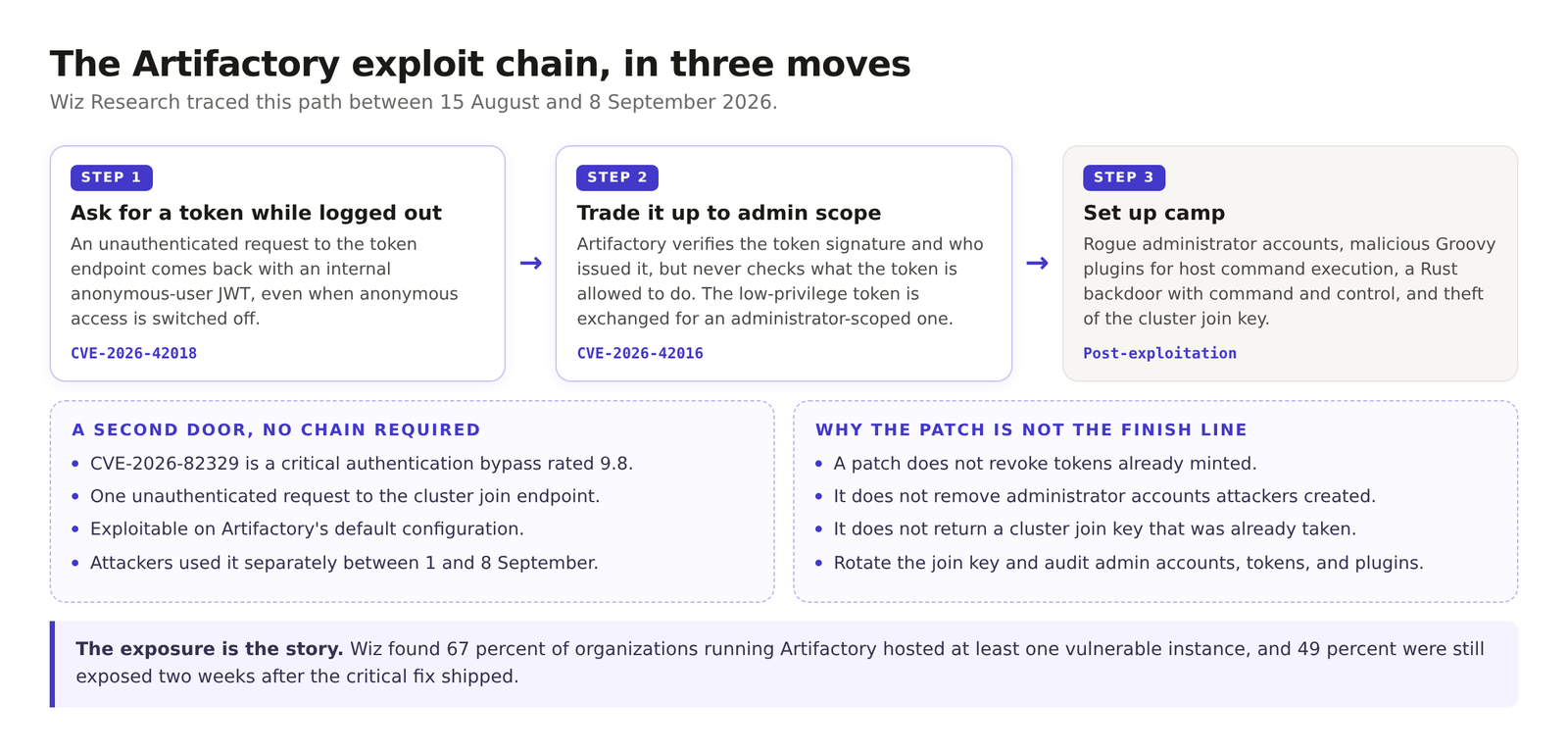
The cloud security firm published a report on September 11 confirming in the wild exploitation of three JFrog Artifactory vulnerabilities. The chain starts with CVE-2026-42018, an improper authentication flaw that hands an unauthenticated caller an internal anonymous user token. That token is low privilege. Then CVE-2026-42016 lets it be swapped for one with administrator scope, because Artifactory checks a token signature and its issuer but not what the token is allowed to do.
A third bug stands alone. CVE-2026-82329 is a critical authentication bypass rated 9.8. Under Artifactory default configuration, an unauthenticated attacker with network access can obtain admin privileges in a single request. The US Cybersecurity and Infrastructure Security Agency added the two chained flaws to its Known Exploited Vulnerabilities catalog on September 11.
The exposure numbers are worse than the exploits
Wiz found 67 percent of organizations running Artifactory hosted at least one vulnerable instance. For CVE-2026-82329, 49 percent were still exposed two weeks after the fix shipped. Patching velocity has been slow, and attackers noticed. Fastly logged roughly 406,000 exploitation attempts across its platform on September 2 alone. Those are attempts, not confirmed compromises.
What attackers did after they got in
Wiz observed persistent administrator accounts created under names such as Nxploited and labadmin, malicious Groovy plugins used to run commands on the host, and a custom Rust backdoor with command and control features dropped in multiple cases. Some intrusions took the cluster join key, the shared secret Artifactory nodes use to trust one another.
The remediation trap is the part most teams will get wrong. A patch does not revoke tokens already minted, and it does not remove admin accounts attackers created. JFrog fixed builds are 7.111.21, 7.117.28, 7.125.20, 7.133.29, 7.146.38, and 7.161.20. Upgrading is step one. Rotating the join key, revoking tokens issued since August 28, and auditing for rogue administrators is the rest.
Related reading. A Software Supply Chain Audit Wants Proof, Not a Longer SBOM and The Container Runtime Wars Are Over. containerd and CRI-O Both Won.
Get the next one before it is old news
Independent analysis of cloud-native infrastructure, Kubernetes and data centre economics. No vendor spin.