

Executive Summary
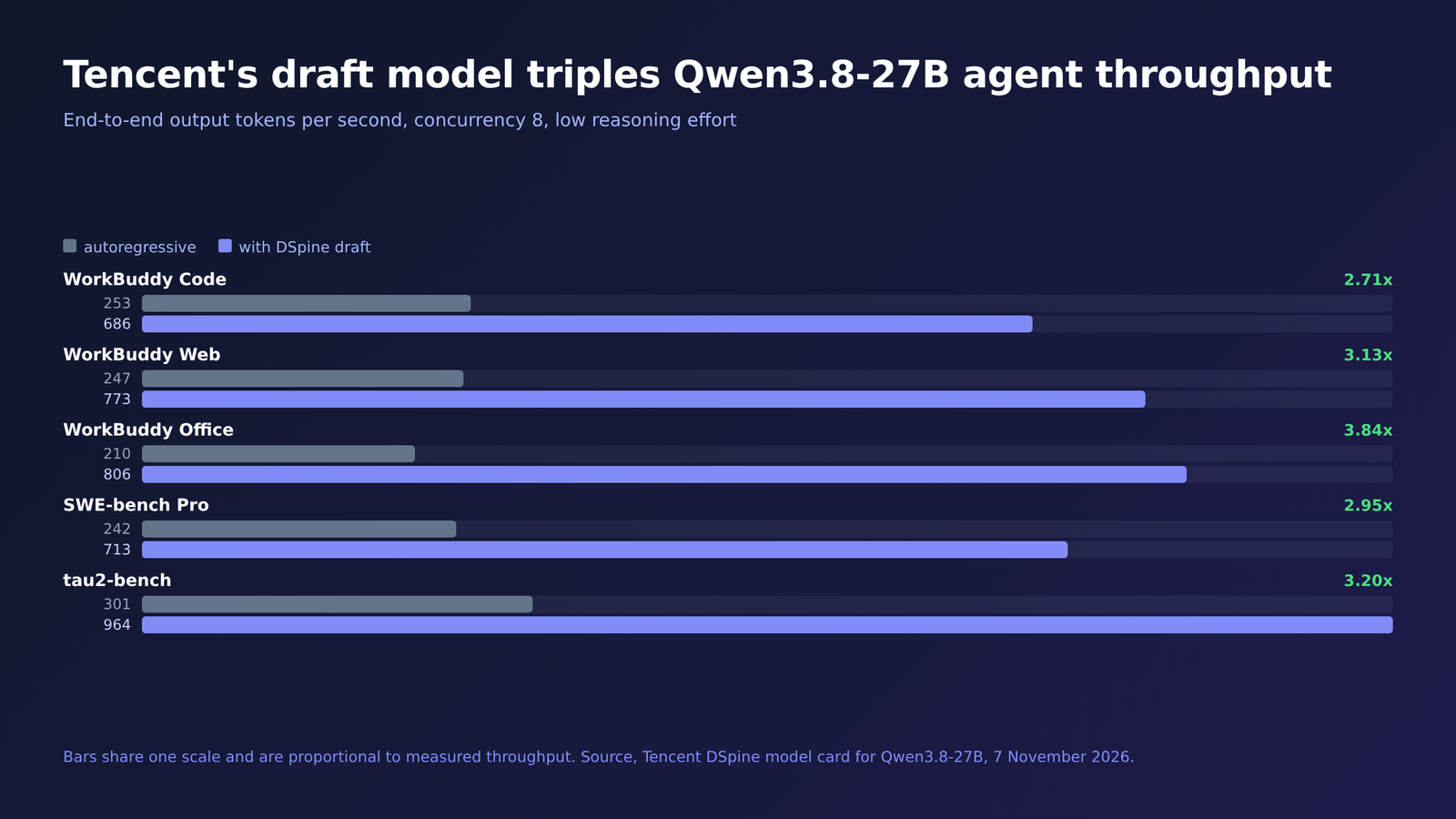
Tencent published a speculative decoding drafter for Alibaba’s Qwen3.8-27B on 7 November, and it lifts end to end agent throughput by 2.7 to 3.8 times in Tencent’s own SGLang tests at concurrency 8. No new weights, no price change, no retrained base model. The file under the hood is the same one operators already downloaded. Only the tokens per second moved.
That matters because Qwen3.8-27B carries 7.81 million downloads on Hugging Face and sits at 41 output tokens per second with a $3.53 bill per benchmark task, against a 15.4 minute median. The download chart and the serving bill told different stories. A five layer drafter closes part of that gap without asking anyone to re host anything. The catch is architectural. Qwen3.8-27B runs linear attention on three of every four layers, so accepting a draft token means rewinding recurrent state. This landed as kernel work in SGLang, not a new model.
Tencent released Qwen3.8-27B-DSpine-b16 at 14.20 UTC on 7 November. It is five layers, Apache 2.0, and a single safetensors file. It cannot answer anything on its own. It guesses the next sixteen tokens so the 27B model can check them all in one pass.
On SGLang 0.5.22 with BF16 and FlashAttention 3 at concurrency 8, the WorkBuddy Office agent tasks go from 210 output tokens per second to 806. That is 3.84 times. The weakest case in the published set is WorkBuddy Code at 2.71 times. Across the five agent benchmarks the average is 3.16 times.
Three of every four layers hold state you cannot take back
On a plain transformer this is simple. Guess ahead, let the large model verify the guesses in parallel, throw away the rejects. The worst case is wasted compute.
Qwen3.8-27B is not that model. Its own config sets full_attention_interval to 4, and the layer list runs three linear_attention layers then one full_attention layer, over and over down the stack. Linear attention carries a recurrent state that advances with every token. Accept a draft token and the state moves forward. Reject one and you have to put the state back.
Read the recommended command in Tencent’s repository and the problem is right there. It enables linear-replayssm-spec, sets the mamba radix cache strategy to extra_buffer, and caps the mamba cache at 64. Those are not model settings. They are the machinery to rewind and replay state across a speculative batch. On a hybrid architecture, a drafter is a cache problem before it is a modeling problem.
The 8B draft was a research result. The 27B one is a serving bill
Tencent had a DSpine checkpoint for Qwen3-8B on 16 October. It has 861 downloads. An 8B draft is a way to publish a method, not a way to save money.
The 27B is different, because that is the size people actually put behind an endpoint. Artificial Analysis measures the base model at 41 output tokens per second, 126.81 seconds to the first answer token, and 44.3 minutes per benchmark task against a 15.4 minute median for its size class. At $0.50 per million input tokens and $3.00 per million output, one evaluated task costs $3.53.
So the arithmetic that matters is not the benchmark score. It is the invoice. Roughly 3.2 times more tokens per second on an unchanged model, at concurrency 8 on one tuning profile, is a different capacity plan for the same hardware. Operators usually wait a model generation for that. It arrived as a five layer add on.
Tencent is faster at speeding up a rival than at releasing its own model
Tencent’s own flagship still has no checkpoint. Hy4 launched on 4 November with a promise that weights and system cards would follow in the coming days. Three days on, the Hugging Face organization offers Hy4 preview from 27 August and nothing else. We wrote about that gap twice this week, and it has not closed.
Meanwhile the same organization spent engineering time making Alibaba’s 27B cheaper to serve. On OpenRouter the hosted Hy4 is the fifth busiest model in the week through 6 November at 7.05 trillion tokens, listed as new, against 56.2 trillion for DeepSeek V4.1 Flash 1017. Tencent is winning usage it does not have to publish a file for, and giving away serving efficiency for a model that competes with its own.
Both moves make sense once the hosted endpoint is the product. A drafter costs nothing to license and pulls developers into SGLang, a serving stack Tencent helps maintain. The flagship weights stay where the margin is. That is coherent, and it is not what the open weights label implies.
Three questions for your own inference estate. What is your measured tokens per second today on the model you serve, rather than the spec sheet number? What is a 3.2 times serving gain worth against the GPUs you have already reserved? And when a lab speeds up a rival’s model while holding back its own weights, which tells you more about where it expects to make money?
Related reading, why the Hugging Face trending board ranks momentum rather than load, the other half of this download versus usage gap.
Get the next one before it is old news
Independent analysis of cloud-native infrastructure, Kubernetes and data center economics. No vendor spin.