


Executive Summary
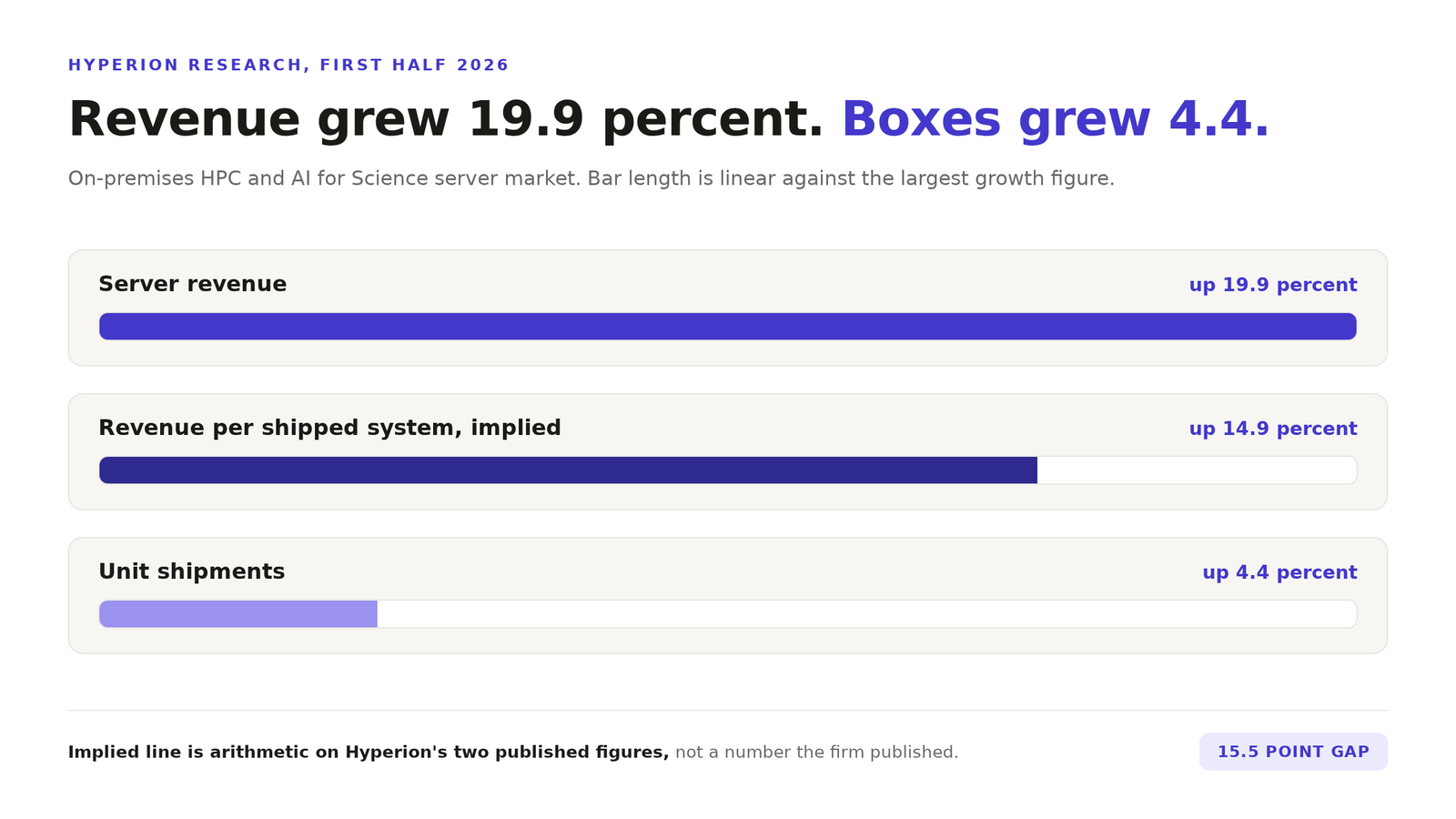
Hyperion Research puts on-premises HPC and AI server revenue at $16.5 billion for the first half of 2026, up 19.9 percent. Unit shipments over the same stretch grew 4.4 percent. Revenue per shipped system is therefore up roughly 15 percent, which means most of the growth headline is component cost, not capacity added. Accelerators raised the bill and memory prices tripled or quadrupled into it.
The second finding matters more. Dell took the top spot at $4.2 billion and 24 percent share, ending an HPE run at the head of this market that lasted more than 25 years. HPE built that record on laboratory scale machines. Dell is winning enterprise AI nodes. So the leadership change and the price gap describe the same shift, and the practical reading for a buyer is that the per node price, not the seat count, is now the budget constraint.
On-premises AI servers grew almost 20 percent in the first half of the year. The market shipped barely more servers, 4.4 percent more. Hyperion Research published both figures in its latest HPC server market update, and the 15 point gap between them is the part worth reading.
The arithmetic is simple. Revenue rose 19.9 percent, units rose 4.4 percent, so revenue per shipped system rose about 15 percent. That is not a demand story with a supply constraint bolted on. It is a price story, and the price is inside the box rather than on the volume line.
Two inputs moved together. Systems now carry more GPU and accelerator content, because that is what buyers want installed. And memory has repriced hard, with costs up by a factor of three or four since last year, as The Register reported in August. A refresh order that was budgeted last spring lands at a different number today, and the difference has nothing to do with how many nodes you asked for. We tracked that squeeze through PC budgets earlier this quarter. Servers are the next invoice in line.
Dell took a crown HPE held for more than 25 years
Hyperion’s update also moved the leaderboard. Dell took the lead on $4.2 billion of server revenue for the half and 24 percent share, as The Register reported. HPE sits at 21 percent after holding the position since the 1990s.
The interesting part is why, and Hyperion’s own words point at it. Earl Joseph, the firm’s chief executive, said in the announcement that the growth reflects both a nominal increase in units purchased and significant increases in system prices, and that Dell had taken full advantage of demand for AI infrastructure. That is a sentence about a change in the buyer, not just a change in the winner.
HPE built its 25 year run on large procurements from national laboratories and research institutions, machines that take years to specify and years to install. Dell has been winning the shorter cycle, where an enterprise decides to put a modest AI cluster in its own building this quarter. Different sales motion, different margin, different node.
Nearly half the market is missing from the share table
Lenovo and Sugon sit at 4 percent each. The other 45 percent of the market does not appear by name at all, because Hyperion files it under others. That bucket contains Bull, which returned to independent life out of Atos this year, plus Supermicro, Penguin Computing and NEC.
So this is not a two horse race and it is not consolidating into one. A fragmented on-prem market is what you would expect when the buyers are institutions with their own procurement rules, their own data residency constraints and their own reasons to avoid a hyperscaler. It also means the vendor concentration story that applies to cloud does not transfer here.
The gap is your next budget conversation
Hyperion’s numbers are a supplier side view, and the operator reading is narrower. If a shipped system costs 15 percent more than it did a year ago for similar capacity, then a flat budget buys fewer nodes, and a capacity plan written last cycle is now short. The fix is not to argue with the analyst. It is to move the line item.
Budget per node and hold the count. Treat memory as a capital constraint with its own approval path rather than a component inside a server quote. And check whether the accelerator mix you specified is the one you can actually fund, because that is the line that moved most. The per node price is also where the rent versus buy argument turns, and that argument has already moved once this quarter.
Three questions for your own refresh plan. What is the per node price on the quote in front of you, and what was it twelve months ago. Does your budget protect node count or total capacity. And if memory stays where it is, which purchase on your roadmap moves to next year.
Get the next one before it is old news
Independent analysis of cloud-native infrastructure, Kubernetes and data center economics. No vendor spin.