

Executive Summary
A yearlong Senate investigation concluded that the seven biggest data center developers will not commit to paying for the new power plants and transmission lines their campuses pull onto the grid. Amazon, Google, Meta, Microsoft, CoreWeave, Digital Realty and Equinix told investigators they would cover the direct cost of serving their own sites, and argued that a larger grid benefits every customer on it.
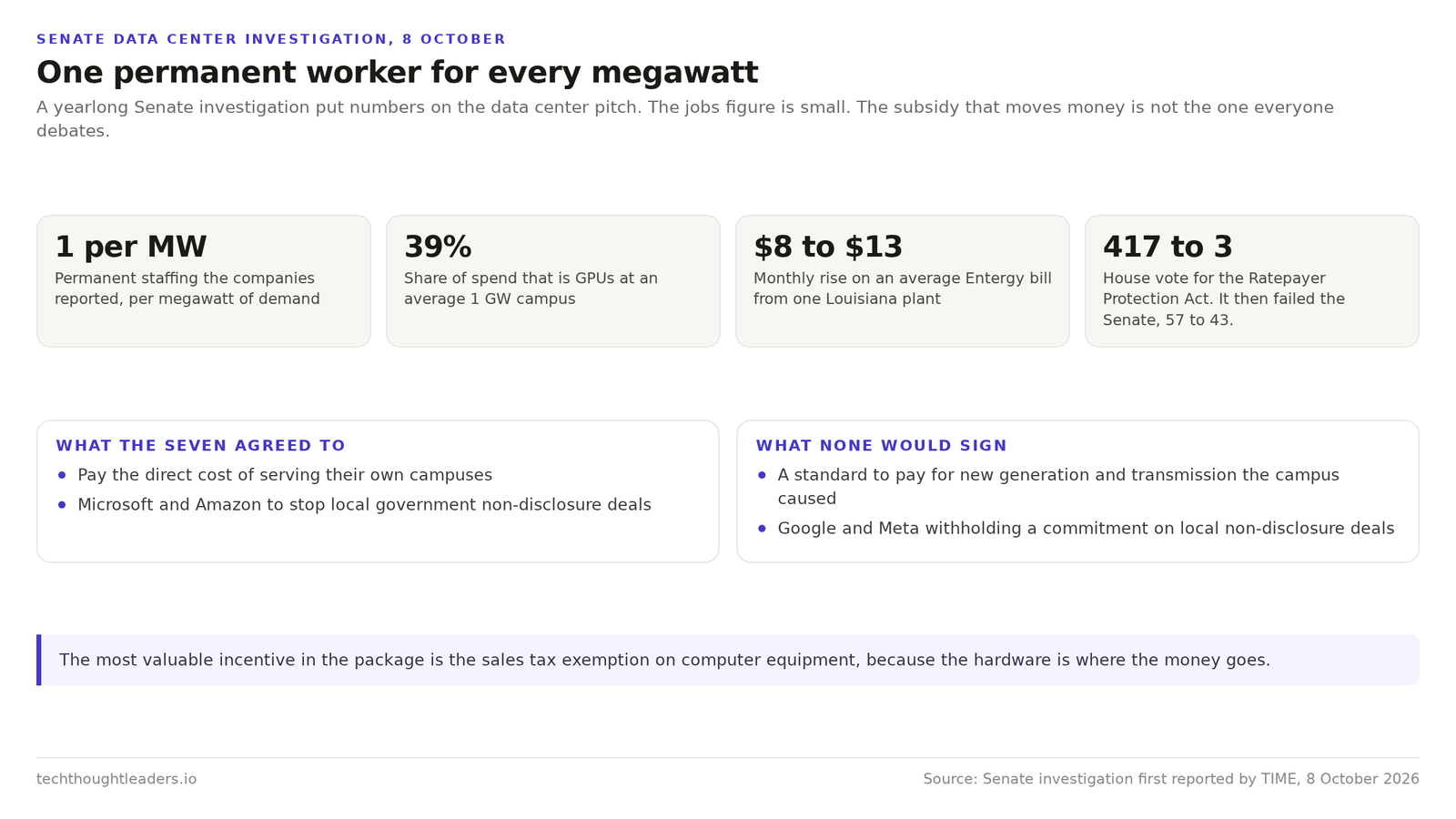
The findings, first reported by TIME on 8 October, also put numbers on the pitch. Companies that answered said permanent staffing runs near one worker per megawatt, so a 100 megawatt campus draws the power of about 100,000 homes and employs about 100 people after construction. The subsidy that moves the most money is the sales tax exemption on computer equipment, because GPUs are an estimated 39 percent of the spend at a one gigawatt campus.
The jobs line is the part of the data center pitch that local officials hear most. A yearlong Senate investigation put a number on it, and the number is small.
Companies that answered the question said permanent staffing runs about one worker for every megawatt of power demand. Run that against a typical campus and the ratio gets stark. A 100 megawatt site draws roughly as much electricity as 100,000 homes. It employs about 100 people once the build is done.
The jobs number is one permanent worker per megawatt
The investigation was led by Senator Elizabeth Warren, with Chris Van Hollen and Richard Blumenthal. It covered seven major developers, Amazon, Google, Meta, Microsoft, CoreWeave, Digital Realty and Equinix. Staff asked each company for employment data and interviewed employees. Several declined to provide detailed information on permanent headcount, according to the report. TIME published the findings first.
Local officials usually justify incentives on construction jobs. Those jobs are real and they end. The permanent number is the one that lasts, and by the companies’ own account it is thin.
The subsidy that pays is the exemption on the GPUs
Here is the finding with the most money attached. Of all the data center subsidies on offer, the sales tax exemption on computer equipment is the one with the biggest number behind it, not the headline property tax break. GPUs alone are an estimated 39 percent of the spending at an average one gigawatt AI campus, so exempting the hardware removes a large share of the taxable cost of the build.
That reframes the argument in statehouses. A county fighting over a property tax abatement may be arguing about the smaller lever while the larger one passes with little notice.
Nobody would sign up to pay for the wire
None of the seven would agree to a standard that makes them pay for new generation and transmission capacity that would not be needed without their campuses. They said they would cover the direct cost of serving their own load, and argued that new plants and lines serve every customer on the system.
The report also went after the paperwork. All four hyperscalers, Amazon, Google, Meta and Microsoft, regularly sought nondisclosure agreements during development, and some acknowledged asking government officials to sign them. Microsoft told investigators it would stop seeking them with local governments while keeping them for state agencies and utilities. Amazon announced a similar policy. Google and Meta declined to commit. An NDA over commercially sensitive terms is ordinary. An NDA over tax dollars, utility rates and public infrastructure is how a community loses the ability to audit the trade.
The Louisiana case is the sharpest example. Entergy has sought to buy a power plant that analysts tie mainly to Meta’s planned campus in Richland Parish, which is expected to draw 4,500 megawatts. Estimates put the impact on the average customer bill at $8 to $13 a month. Meta disputes that its project is responsible.
Congress has a bill for this. The House passed the Ratepayer Protection Act 417 to 3 in September, directing states to consider making large loads cover the incremental cost of the generation, transmission and distribution they require. It then failed in the Senate, 57 to 43, on the argument that it left the standard optional. About half of Americans now say data center construction is bad for the country, per an Economist and YouGov poll.
The demand behind the fight is not in dispute. The US Energy Information Administration flags data center load in its short-term outlook, and the growth is landing on grids that were not built for customers who arrive by the gigawatt.
Three questions for anyone siting capacity now. Which of your incentives is the hardware exemption, and what does it cost the state. Who has signed on the record to pay for the new wire, not the connection fee. And what happens to your timeline if the next Congress writes a national standard instead of leaving it to fifty states.
Related reading. We tracked the Louisiana figure when it first surfaced, in the 4,500 megawatt disclosure, and the Texas decision to charge large loads for their place in the queue.
Get the next one before it is old news
Independent analysis of cloud-native infrastructure, Kubernetes and data center economics. No vendor spin.