


Executive Summary
Broadcom did not lose VMware customers when it cut IBM out of its cloud partner program. It moved them. IBM has sold contracts for hundreds of enterprises running VMware Cloud Foundation in IBM Cloud to 11:11 Systems, a Broadcom partner that runs its own VMware cloud. The licence stays with Broadcom. The customer stays on VMware. Only the operator changes.
This is how the vendor runs the channel now. Partner rights are a privilege, not a given, and Broadcom trims the roster to companies that commit to VMware Cloud Foundation. Accounts that leave a cut partner get steered to one that stayed. 11:11 calls the deal its eighth VMware service provider acquisition. Read it as the shape of the next two years, not a one-off.
IBM is out of the VMware cloud business, and it left through the side door. The company has sold contracts for hundreds of enterprise VMware customers to 11:11 Systems, a managed infrastructure provider and a Broadcom partner. 11:11 confirmed the deal on 8 October. Financial terms were not disclosed.
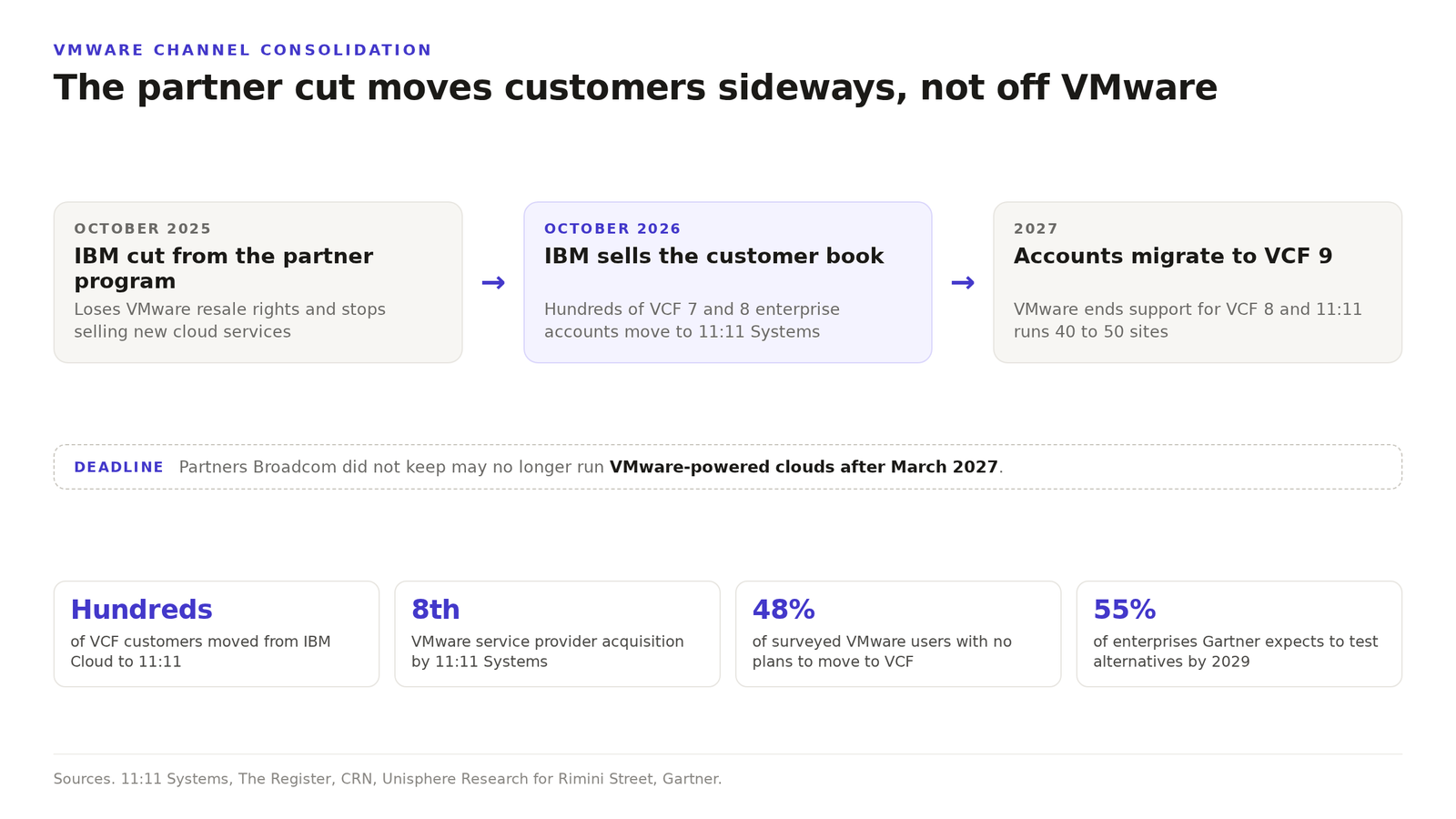
Broadcom cut the channel and the customers moved, they did not leave
Under Broadcom, VMware has trimmed the number of cloud service providers it keeps on the books. Partners the company dropped lost the right to resell its software as of October 2025 and may not run VMware-powered clouds after March 2027. IBM was once a top VMware partner. It stopped selling new VMware cloud services in late 2025, which suggests it was not invited to continue in the program.
The accounts 11:11 picked up run VMware Cloud Foundation versions 7 and 8. That detail matters. VMware ends support for VCF 8 next year, so every one of these customers has to migrate anyway. 11:11 chief executive Brett Diamond called them ripe for migration and said the plan is to move them onto VCF 9.
Nobody here abandoned VMware. The licence holder never changed. What changed is the operator running the cloud underneath, and Broadcom collects the subscription either way.
The deal is channel strategy, not a rescue
This is 11:11’s eighth purchase of a VMware cloud service provider and its eleventh acquisition overall. The company runs 40 to 50 points of presence and claims more than 6,000 customers. Buying a book of enterprise contracts is faster than winning them one at a time.
For Broadcom the math is simple. Fewer cloud partners, each fully committed to VMware Cloud Foundation, is easier to manage and easier to support than a long tail. Ram Velaga, president of Broadcom’s Infrastructure Software Group, framed the deal as support for customers modernizing on the platform.
The counterargument is antitrust. The European cloud group CISPE argues Broadcom has concentrated the market for VMware cloud providers and is pursuing a case in EU courts. Broadcom disputes that. Either way, the number of places a customer can run VMware keeps shrinking.
The accounts Broadcom keeps are not the ones it wanted
The consolidation holds customers on VMware in the short term. Their intent says otherwise. A Unisphere Research survey of 269 VMware customer organizations, commissioned by Rimini Street, found that 90 percent cite higher licensing costs as a reason to evaluate alternatives. Forty-eight percent have no plans to move anything to VMware Cloud Foundation.
Gartner expects the pressure to build. It forecasts that 55 percent of enterprises will start proofs of concept for alternatives by 2029, up from 25 percent in 2026. Move the accounts to a smaller set of partners and you still hold them. You do not change what they want.
What to watch is not whether VMware loses customers. It is where those customers land, and how few stops remain between them and Broadcom. Three questions for your own estate. Which of your VMware cloud contracts sit with a partner Broadcom still authorizes beyond March 2027? What is your migration path if that partner is cut? And does a VMware Cloud Foundation renewal still make sense if the operator underneath it changes twice in three years?
Related reading. Our earlier look at why VMware migrations stall on operational complexity covers the other half of this story.
Get the next one before it is old news
Independent analysis of cloud-native infrastructure, Kubernetes and data center economics. No vendor spin.