


Executive Summary
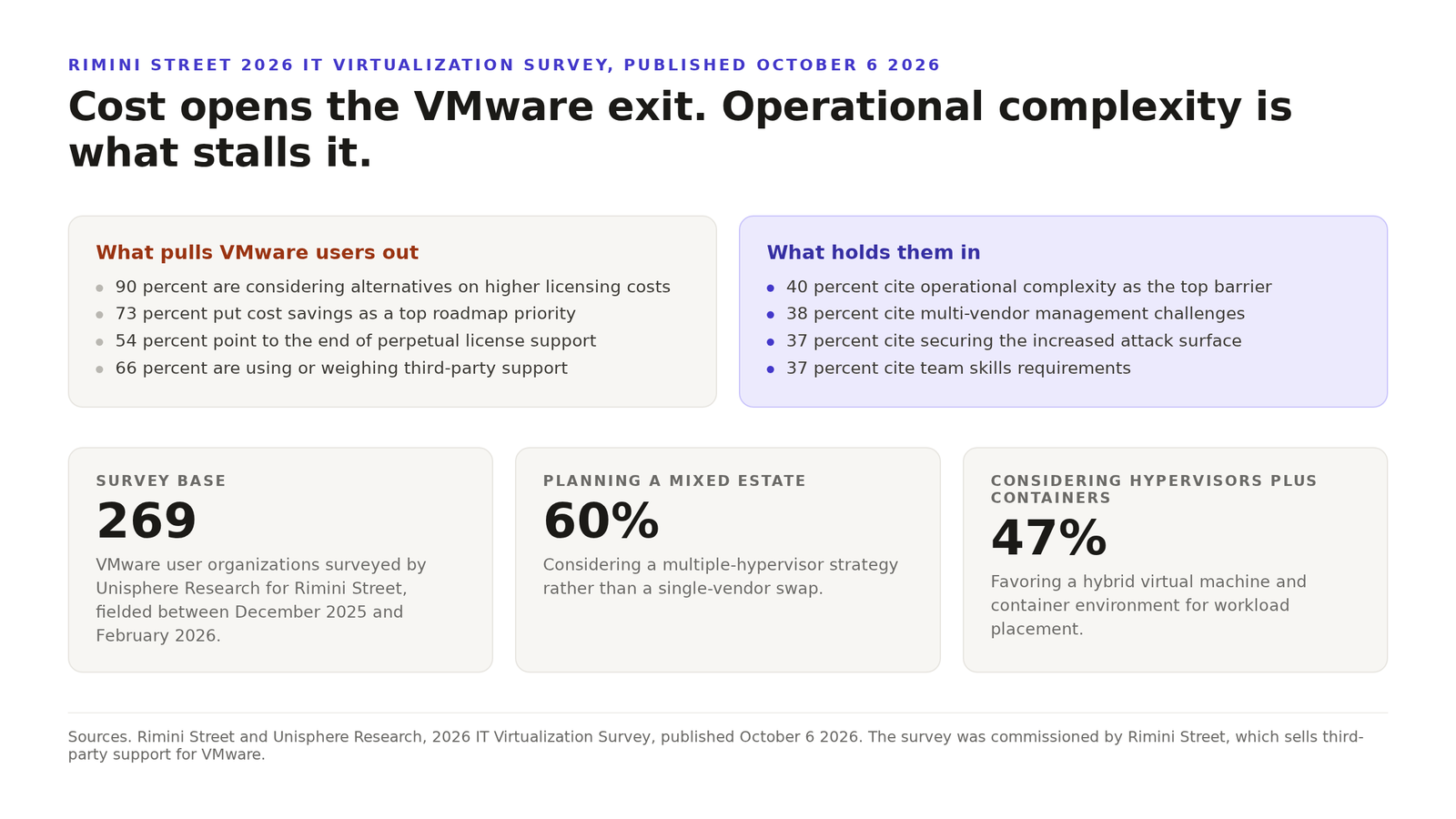
A survey of 269 VMware user organizations found 90 percent are considering alternatives because of higher licensing costs, and 73 percent put cost savings at the top of their roadmap. The VMware exit is not waiting on a decision to leave. It is waiting on the work that leaving requires.
The same respondents named operational complexity, at 40 percent, as the top barrier to progress, ahead of multi vendor management at 38 percent, attack surface at 37 percent and team skills at 37 percent. The shape of the answer is not a clean swap. Sixty percent are weighing a multiple hypervisor estate and 47 percent want hypervisors and containers side by side. Cost starts the VMware exit, and complexity decides whether it finishes.
Almost no VMware customer is pretending the renewal is fine. The interesting number is not how many want to leave. It is what stops them. Rimini Street published the 2026 IT Virtualization Survey on October 6, built on responses from 269 executives, managers and professionals at VMware user organizations. The survey was commissioned by Rimini Street, which sells third party support for VMware, so weigh the framing. The barrier finding is the part worth keeping.
The timing matters. The survey was fielded between December 2025 and February 2026, so the answers predate the September partner cull that removed Insight Enterprises from North America resale. The direction has only hardened since.
A hypervisor swap drags the whole estate with it
Cost is the trigger and it is nearly universal. Ninety percent cite higher licensing costs, 54 percent point to the end of perpetual license support, and 73 percent rank cost savings first. But a hypervisor does not run alone. Backups, monitoring, networking, storage, runbooks and certifications all sit on top of it, and each one has to move or be rebuilt. That is operational complexity, and 40 percent of respondents name it as the top barrier, ahead of multi vendor management at 38 percent, attack surface at 37 percent and team skills at 37 percent.
The bill and the blocker are different problems, and teams keep solving the wrong one. Cutting licence cost is a negotiation with Broadcom. Cutting operational complexity is a project of its own, and it is the project that actually gates the exit.
The exit people are choosing is a mixed estate, not a clean swap
Only a minority describe a single vendor replacement. Sixty percent are considering a multiple hypervisor strategy, and 47 percent favor a hybrid environment that runs virtual machines and containers together. Two thirds are using or considering third party support, and they name security first at 60 percent, installation support at 57 percent and service quality at 54 percent.
The multiple hypervisor answer is the practical one. It keeps the estate running while the team builds the skills, the automation and the runbooks that a full move needs. It also spreads the risk that any single vendor changes its terms again.
What to do this quarter
Three questions for anyone holding a VMware renewal. Which of your dependencies actually block a move, the hypervisor or the tooling stacked on it? If you ran a second hypervisor beside the first for a year, what would break? And does your budget treat the exit as a licence line, when the survey says it behaves like an operations project?
Related reading. Broadcom cut a Pinnacle partner from North America resale, which is the sort of move that sits behind the 90 percent. The Gartner virtualization grid reads as a VMware exit shortlist. And a full VMware exit costs more than three years of Broadcom’s bill, which is the arithmetic this survey finally puts a shape on.
Sources. Rimini Street published the 2026 IT Virtualization Survey with Unisphere Research on October 6 2026. Ars Technica covered the findings the same day. VMware and Broadcom set the licensing terms the survey measures.
Get the next one before it is old news
Independent analysis of cloud-native infrastructure, Kubernetes and data center economics. No vendor spin.
[…] reading. Our earlier look at why VMware migrations stall on operational complexity covers the other half of this […]