


Executive Summary
Two compute futures contracts begin trading on CME on 5 October, settling against a daily index of on demand H100 and B200 rental rates published by Silicon Data. Each contract fixes one month of GPU capacity, 730 GPU hours, and settles in cash rather than in hardware. It is the first public, regulated price for the resource every AI system runs on.
The effect is not cheaper compute. It is that the cost of an AI hour becomes a number an operator can look up and a business can hedge. Neoclouds can sell capacity forward, labs and lenders can fix a cost base, and everyone else gets a forward curve for a line item that has been negotiated in private until now. Read the index carefully. It tracks neocloud on demand rates, not hyperscaler reserved contracts, so it prices the market our readers actually buy from rather than the one the largest buyers lock in.
Compute has been the largest input cost in enterprise AI and the least measurable. Two buyers renting the identical H100 for the same month could pay rates that differ by half, and neither had a public reference to say which deal was better. That gap closes on Monday. CME Group and Silicon Data set the listing date in advance, and the contracts carry effective terms at CME.
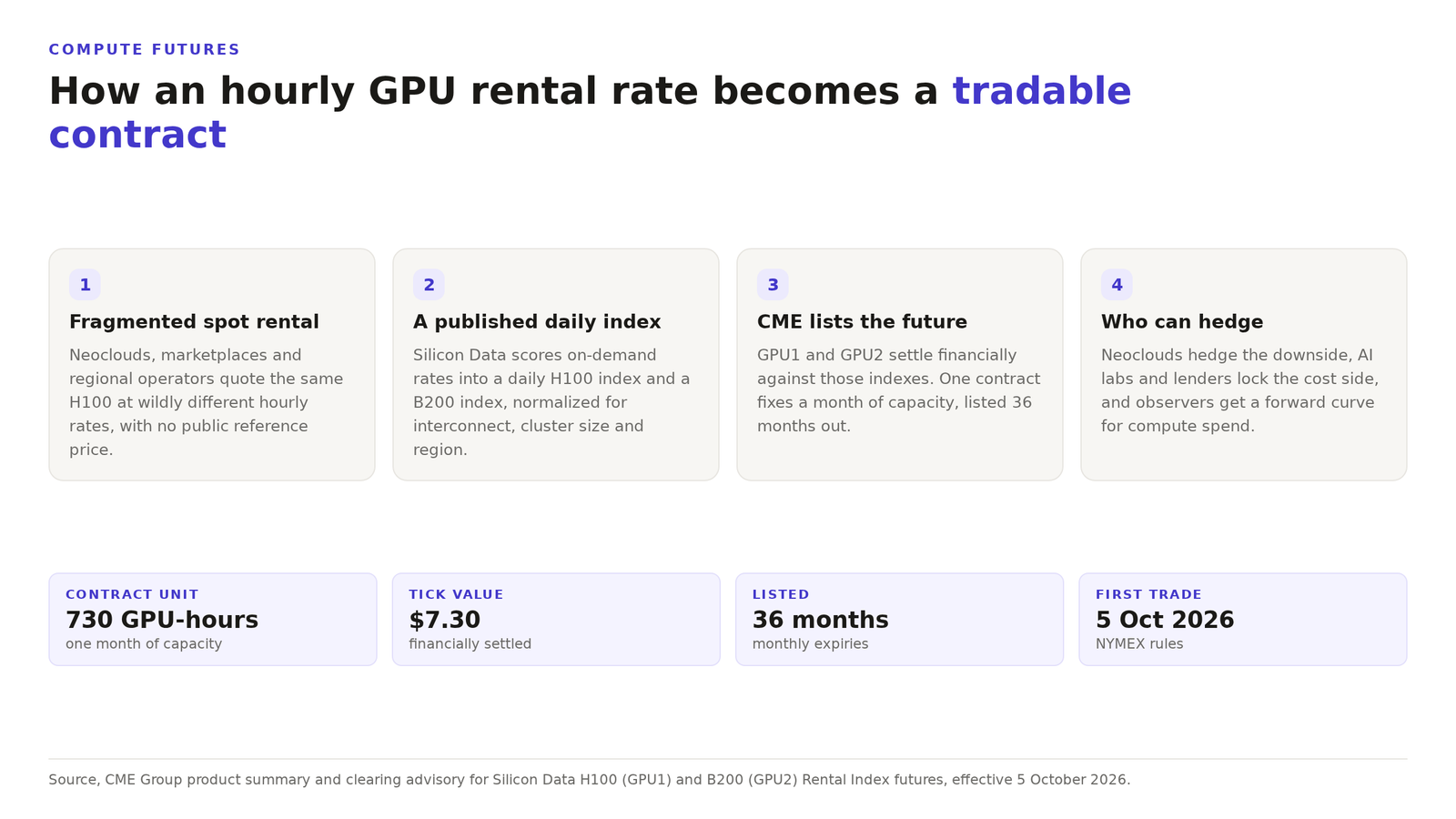
The mechanism is a benchmark plus a contract. Silicon Data, a benchmark firm backed by the trading house DRW, publishes a daily on demand rental index for the H100 and the Blackwell B200. The index pulls neocloud, marketplace and regional prices and normalizes them for interconnect type, cluster size, geography and performance variance. CME Group then turns that index into something you can trade.
A Contract Is Just a Month of Rented Time
The unit is deliberately boring. One contract represents 730 GPU hours, which is one GPU rented continuously for a month. It settles financially, so nobody delivers a server, and each tick is worth $7.30. The two products list under the codes GPU1 and GPU2, run out 36 months, and trade under NYMEX rules.
That structure is the point. A futures contract is only useful when the underlying is standardized enough to compare. Renting a GPU has not been, which is why the market has behaved like a bazaar. Fix the unit and the expiry and you get a price that means the same thing to a neocloud in Iowa and a bank in London.
Three Groups Gain, and One of Them Is Not Buyers
The clearest winners are neoclouds. A GPU rental business carries concentrated revenue and heavy debt against hardware whose residual value is still argued over. A forward curve lets that business sell next year’s capacity at a known price instead of watching spot rates move underneath a loan.
AI labs and their lenders gain the other side of the same trade. A lab that has to commit to multi year capacity can fix a cost base rather than accept whatever the market charges when a cluster comes online. A lender underwriting GPU backed debt gets a market signal for what the collateral can earn, which is a better input than a useful life assumption typed into a spreadsheet.
Buyers of compute gain least. Hedging stabilizes a cost, it does not lower it. Where the forward curve sits above today’s spot, a buyer locking in is paying for certainty.
What the Contract Does Not Price
Three gaps matter. The index tracks neocloud on demand rates, so it does not represent a hyperscaler reserved contract, and an enterprise on a three year commitment is not buying the thing being hedged. Liquidity at launch is likely to be thin, which makes an early printed price a weak signal until volume arrives. And compute is not oil. A barrel is fungible across the world, while an H100 hour carries a location, an interconnect and a software stack with it.
None of that makes the contract useless. It makes it a first reading on a market that has been opaque by default. The number to watch is not the launch print. It is whether open interest builds past the first few months, because that is the difference between a benchmark and a novelty.
Related reading. For the rental market this contract prices, see our look at GPU rental prices and token economics. For who ultimately pays the compute bill, see Anthropic and the infrastructure obligations behind its numbers.
Get the next one before it is old news
Independent analysis of cloud-native infrastructure, Kubernetes and data center economics. No vendor spin.