

Executive Summary
Running AI agents is a sandbox problem wearing a workload costume. Each agent executes code, browses the web and calls tools, so a prompt injection becomes an escape attempt. Edera published Project Lunchbox on 17 September with three primitives for the Kubernetes clusters a company already runs. Every agent gets its own microVM and private kernel. A running agent can be frozen with its state intact. A warm agent can be cloned into children that share memory until a write.
The cost argument carries as much weight as the security one. Production agent fleets spin up thousands of runs at once, and an agent waiting on a slow tool call still holds CPU and memory. Freezing turns idle time back into capacity. Kubernetes 1.37 already ships pod checkpoint and restore as alpha. The primitives are arriving from two directions at once, and that is the signal worth watching.
Edera published Project Lunchbox on 17 September. The pitch is blunt. Managed sandbox clouds sell agent execution as a service, and Edera wants that execution to stay on hardware you already own.
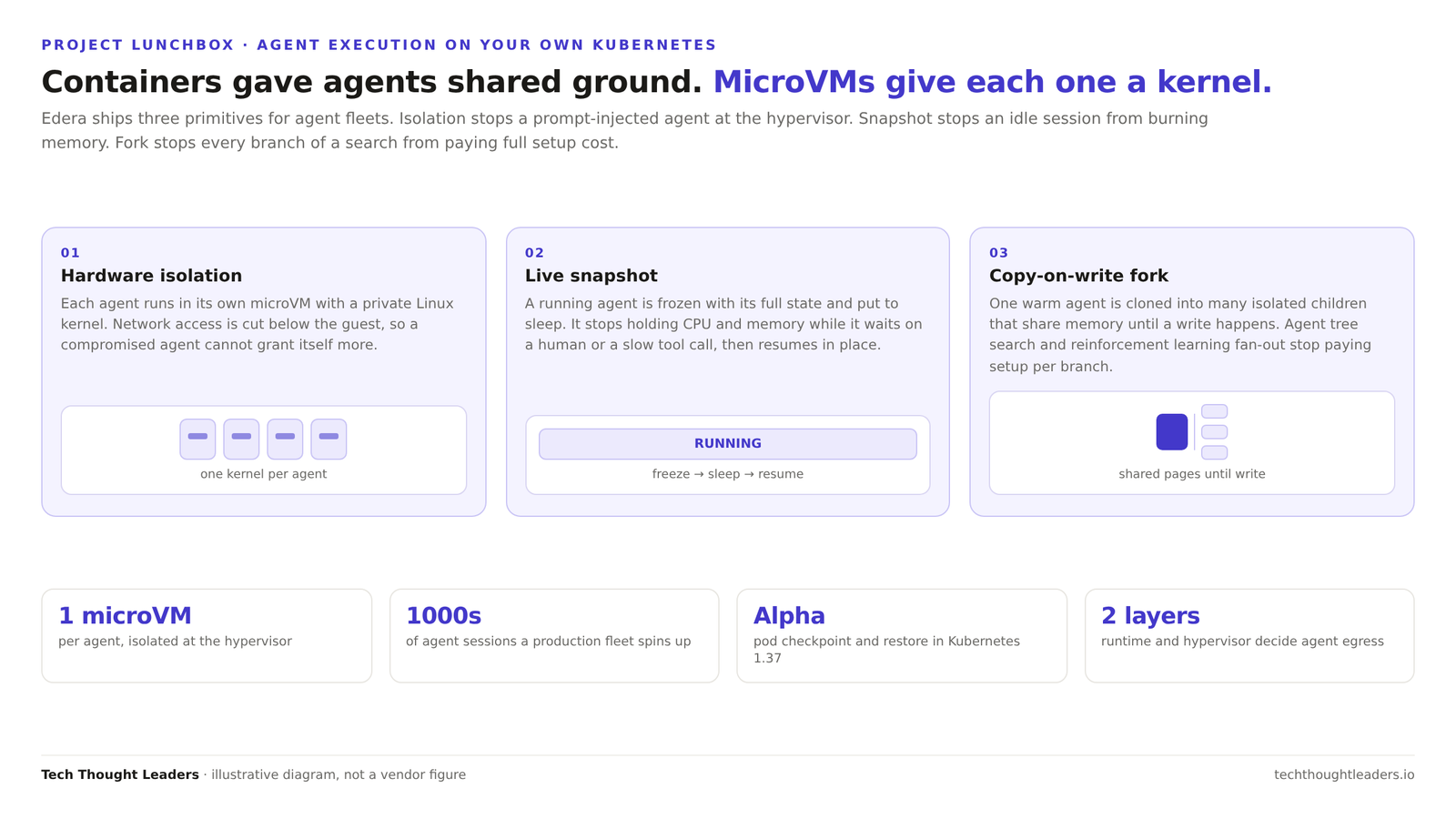
The company frames it as a capability set rather than a new product line, and it lands on a cluster you operate. Edera has shipped three primitives. Hardware isolation puts every agent in its own microVM with a private Linux kernel, so network reach is cut below the guest. Live snapshotting freezes a running agent and restores it later. Copy-on-write forking clones a warm agent into many isolated children that share memory until something changes.
Containers share one kernel, and agents make that matter
A container is a set of namespaces and cgroups over a single shared kernel. One local privilege escalation bug in that kernel reaches every tenant on the node, which is what made the kernel flaws disclosed on 18 September worth reading closely. The shared-kernel bet works for stateless services behind a load balancer. It gets harder to defend when the workload writes and runs its own code.
The case for stronger AI agent isolation on Kubernetes is not theoretical. A coding agent with repository access sits one poisoned instruction away from trying to send source code to an address it picked. A hypervisor boundary answers that better than a namespace boundary, because the agent cannot widen its own network reach. Edera enforces egress at the runtime and hypervisor layer, below the guest kernel the agent runs on.
Snapshot and fork are the cost story, not the security story
Security sells the sandbox. Cost pays for it. A production agent fleet spins up thousands of runs at once, and each run holds memory while it waits. An agent blocked on a human review, a slow tool call or a rate limit burns the same resources as one doing work.
Live snapshotting turns that idle time back into capacity. Freeze the agent, keep its state on disk, release the compute, wake it where it stopped. Copy-on-write forking attacks the other half of the bill. Agent tree search and reinforcement learning fan-out want many branches from one starting point, so cloning a warm agent and letting the children share pages until a write removes most of the setup cost per branch.
Both primitives come from a runtime that already had to solve them. gVisor and other sandbox runtimes made the isolation argument years ago. Snapshot and fork are the parts that make the economics work at fleet scale.
Kubernetes is growing the same primitives from below
The clever part is that Edera does not have to invent the interface. Kubernetes 1.37 shipped pod checkpoint and restore as an alpha feature, which exposes the runtime capability through the Kubernetes stack instead of a vendor-specific API.
That work has roots. The checkpoint and restore working group has been pushing the primitive into the container runtime interface since early 2026, and the earlier CRI implementation leaned toward forensics rather than agent workflows. The direction still holds. The sandbox layer decides how agents execute, and it is drifting toward the platform.
Read the announcement as a bet on that drift. Edera argues the open path runs through Kubernetes rather than a managed sandbox cloud, and it built the primitives it needs to make the argument concrete. The managed harnesses are already here, and the runtime question never closed. What changed this week is that the sandbox stopped being an abstraction and started shipping as pods, snapshots and forks.
Get the next one before it is old news
Independent analysis of cloud-native infrastructure, Kubernetes and data centre economics. No vendor spin.